
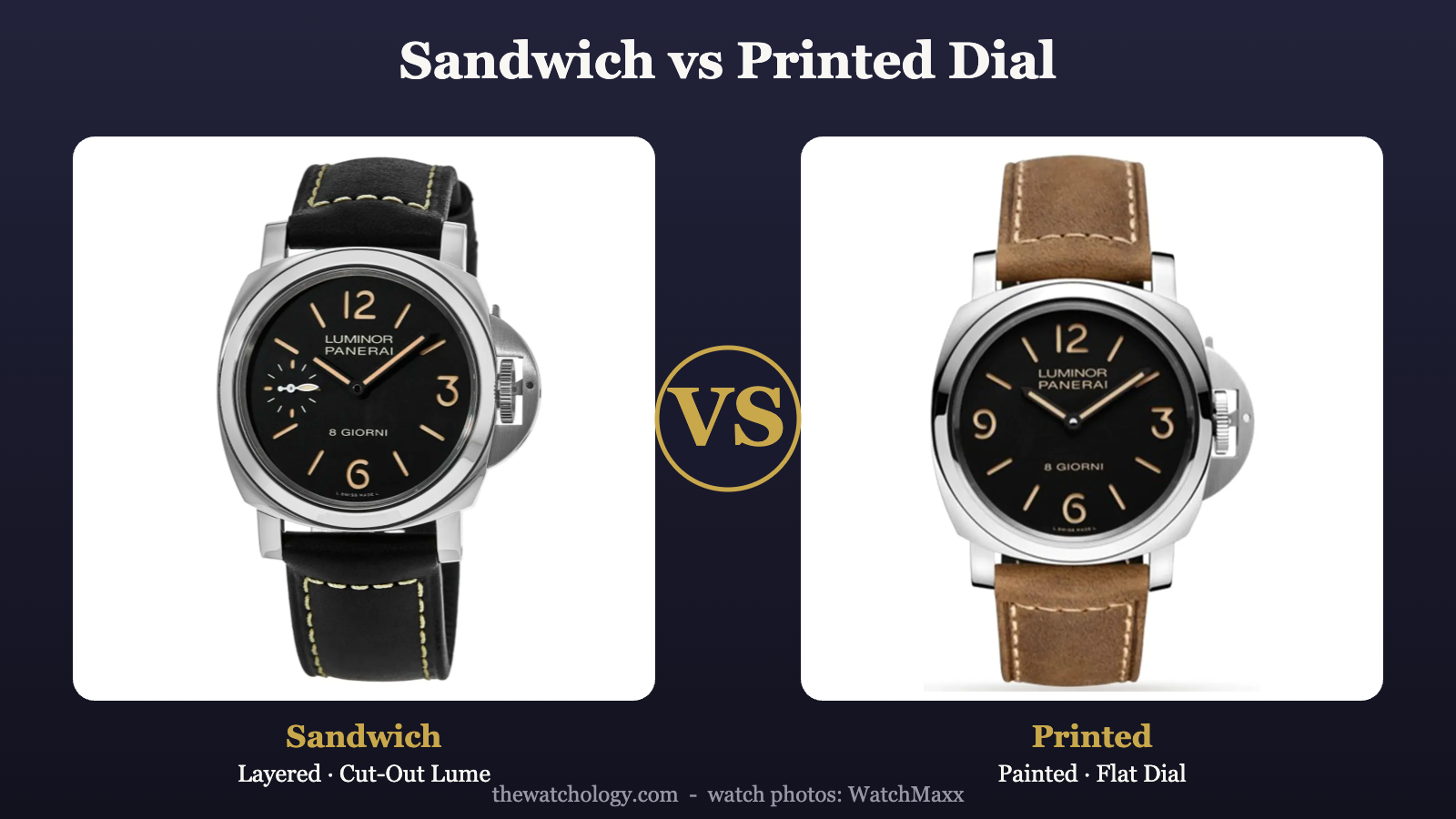
The sandwich dial is one of Panerai’s most iconic features — but the brand also makes printed dials, and the difference affects depth, legibility and that unmistakable glow. A sandwich dial layers luminous material beneath cut-out numerals, while a printed dial paints the markers directly onto a single surface. This guide explains how they differ and which to look for.
Prices and specifications as at June 2026. Always verify with authorised dealers or trusted sellers.

TL;DR — Sandwich vs Printed Dial
A sandwich dial uses two stacked discs: a luminous lower layer shows through cut-out numerals and indices in the upper disc, creating real depth and a strong, even glow. A printed dial applies the numerals and lume directly onto a single flat surface — cleaner and flatter, often slightly more legible in bright light, and usually a touch more affordable to produce. Sandwich dials are the more iconic, more three-dimensional Panerai look; printed dials are crisp and uniform. Choose sandwich for depth and heritage, printed for flat clarity.
Table of Contents
- Panerai’s Signature Dial
- How Each Dial Is Made
- Depth, Lume & Legibility
- Which Panerais Have Which
- Which Looks Better?
- Value & Desirability
- Who Should Pick Which?
- Final Verdict
- Frequently Asked Questions
Panerai’s Signature Dial
If there is one detail that defines Panerai’s look, it is the sandwich dial. Born from the brand’s military heritage — where maximum night-time legibility was a genuine operational requirement — the sandwich construction gives Panerai dials their characteristic depth and powerful glow. But not every Panerai uses one. Across the range you will also find printed dials, where the numerals and luminous material are applied directly to a single surface. Both are legitimate, well-executed approaches, and knowing the difference helps you understand what you are looking at and which you prefer.
You can see the contrast clearly in two references from the same family: the PAM00915 Luminor 8 Giorni uses a sandwich dial, while its sibling the PAM00914 uses a printed dial. We compare those two directly in our PAM914 vs PAM915 guide, but the dial principle applies across the whole catalogue.

| Aspect | Sandwich Dial | Printed Dial |
|---|---|---|
| Construction | Two stacked discs, cut-out markers | Single flat surface, printed markers |
| Depth | Recessed, three-dimensional | Flat |
| Night glow | Broad, even, very strong | Good, more localised |
| Daylight contrast | Excellent | Crisp, often very high |
| Look | Heritage, iconic Panerai | Clean, modern, uniform |
| Collector appeal | Strong (signature look) | Authentic, often better value |
How Each Dial Is Made
A sandwich dial is built from two stacked discs. The lower disc is coated entirely in luminous material; the upper disc, sitting on top, has the numerals and indices cut out of it. Looking at the dial, you see the glowing lower layer through those cut-outs. This construction creates genuine physical depth — the markers sit slightly recessed — and because the entire lower disc is lume, the glow is broad, even and powerful at night.
A printed dial takes a single dial surface and prints or paints the numerals, indices and luminous material directly onto it. There is no second layer and no cut-outs, so the dial is flat. The lume is applied as printed markers rather than glowing through openings. Printed dials are simpler to produce and can be very crisp and uniform, but they lack the layered, recessed depth of the sandwich style.

Depth, Lume & Legibility
The sandwich dial’s biggest advantages are depth and glow. The recessed, cut-out markers give the dial a three-dimensional quality that catches the light beautifully during the day, and at night the broad luminous layer produces an exceptionally strong, even glow — the original point of the design. The trade-off is that, in very bright daylight, the recessed markers can occasionally read with slightly less contrast than crisp printed ones.
The printed dial’s strengths are flatness and crisp uniformity. The markers can appear sharply defined and high-contrast, which some find marginally more legible in bright conditions, and the flat surface gives a cleaner, more modern look. Its night-time glow is still good, but typically not as broad or dramatic as a full sandwich layer. In short: sandwich wins on depth and lume drama; printed wins on flat, crisp clarity.
Which Panerais Have Which
Sandwich dials appear across many of Panerai’s most iconic references — the Luminor Marina, Luminor 1950, and numerous Submersibles use them, and collectors strongly associate the sandwich look with “proper” Panerai. Printed dials show up on certain references where a flatter, cleaner look or a different production approach is intended, such as some Luminor 8 Giorni and entry variants. When shopping, it is worth checking which dial a specific reference uses, because two otherwise similar watches (like the PAM00914 and PAM00915) can differ on exactly this point.
Which Looks Better?
This is subjective, but most Panerai enthusiasts gravitate to the sandwich dial precisely because it is the brand’s signature — the depth and glow feel quintessentially Panerai. That said, plenty of buyers prefer the clean, flat, high-contrast look of a printed dial, especially those who want a more modern or uniform appearance. Neither is “wrong.” If heritage and three-dimensional depth matter to you, sandwich; if you like crisp flatness, printed.
Value & Desirability
Because the sandwich dial is so strongly associated with Panerai’s identity, sandwich-dial references often enjoy slightly stronger collector desirability, which can support resale. Printed-dial models are no less authentic and can offer excellent value, particularly for buyers who prefer that look. As always, the specific reference, condition and completeness matter far more than the dial type alone. For broader context, see our buying guide and Is Panerai Worth It?
Who Should Pick Which?
Pick a sandwich dial if: you want the quintessential Panerai look. The layered depth, recessed cut-out markers and powerful, even glow are the brand’s signature, and for most enthusiasts the sandwich dial is simply what a “real” Panerai should have. It is the choice for heritage and three-dimensional character.
Pick a printed dial if: you prefer a flatter, crisper, more uniform face. Printed dials give a clean, high-contrast look that some find more modern and marginally more legible in bright light, often at a slightly more accessible price. It is the choice for clarity and simplicity.
If the iconic Panerai depth and glow matter most, go sandwich. If you value flat, crisp legibility, printed is a perfectly good — and authentic — choice.
Final Verdict
The sandwich dial is Panerai’s signature for good reason: its layered depth and dramatic glow are part of the brand’s DNA. But the printed dial is a crisp, clean, fully authentic alternative. Choose a sandwich dial for heritage, depth and an exceptional night-time glow, or a printed dial for flat, high-contrast clarity. Both are well-executed — let your taste for depth versus flatness decide.
Leave a Reply
You must be logged in to post a comment.