
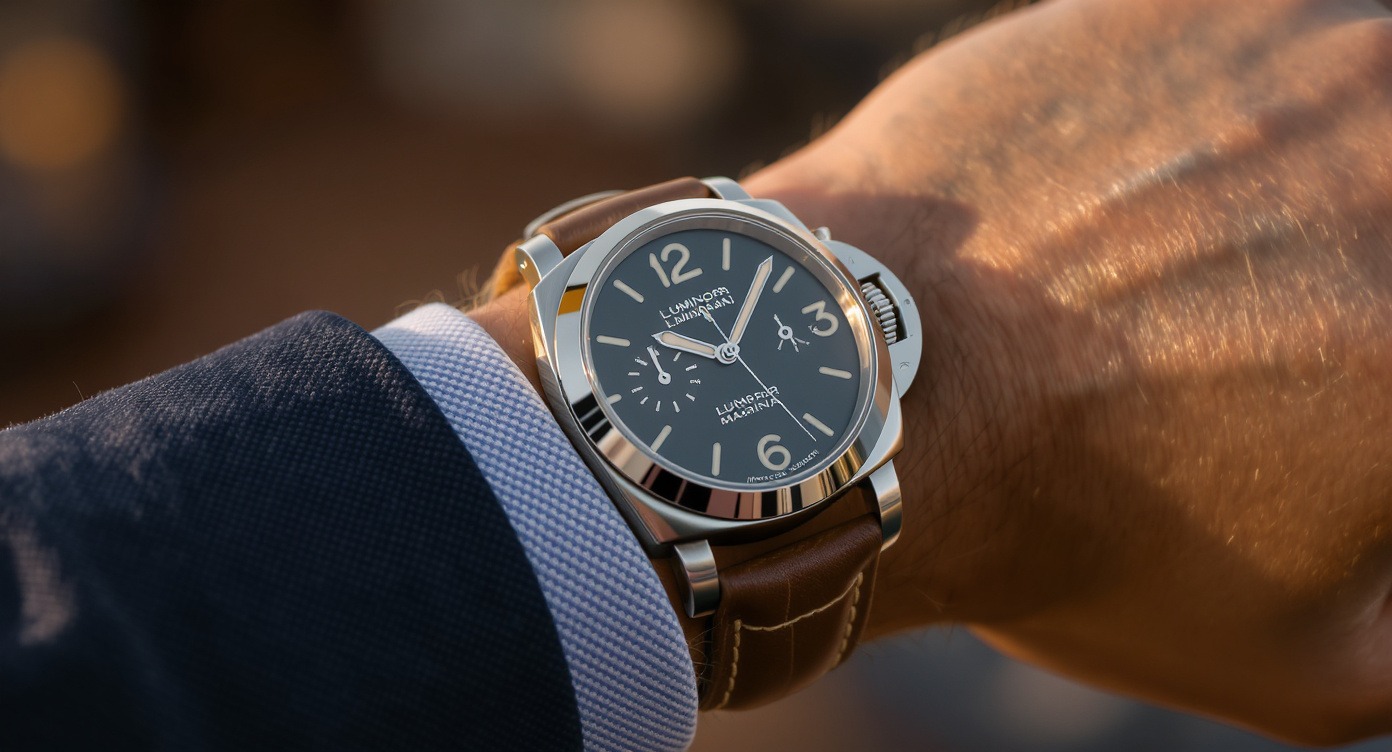
“Are Panerai watches worth the money?” is one of the most debated questions in the luxury watch world. On collector forums, the responses range from passionate defence to harsh criticism. This guide cuts through the noise with an honest analysis of what you get for your money, where Panerai excels, where it falls short, and whether the brand deserves a place in your collection in 2026.
Prices and specifications as at June 2026. Always verify with authorised dealers.

Table of Contents
- The Great Panerai Debate
- What You Get for the Money
- Panerai Pricing in 2026
- In-House Movements: The Turning Point
- The Design Factor: Why Panerai Stands Alone
- Resale Value: The Uncomfortable Truth
- How Panerai Compares to Competitors
- Who Should (and Should Not) Buy a Panerai
- Final Verdict: Is It Worth It?
- Frequently Asked Questions
The Great Panerai Debate
Few luxury watch brands polarise opinion like Panerai. Rolex has universal respect. Omega has broad appeal. But Panerai divides the room. Critics argue the watches are too large, too simple for their price, and depreciate too steeply. Defenders counter that Panerai offers a uniqueness of design that no other brand replicates at any price.
The criticism intensified during Panerai’s ETA era, when many models used modified third-party movements in watches costing USD 5,000 and above. Forum discussions from that period are pointed, with collectors asking why they were paying luxury prices for movements available in far less expensive watches. This was a legitimate complaint that coloured perceptions for years.
But Panerai in 2026 is a fundamentally different proposition. The shift to in-house movements, the refinement of case construction, and the expansion to more wearable sizes have addressed many historical criticisms. The question is whether those improvements justify current price tags.
What You Get for the Money
Case construction: Excellent. The cushion case is precisely machined from solid steel, with clean transitions between polished and brushed surfaces. The lever-lock crown guard is a genuine engineering feature that provides a positive seal and a tactile interaction unique in watchmaking. Build quality is comparable to Rolex and Omega at equivalent price points.
Dial quality: The sandwich dial remains Panerai’s trump card. The two-layer construction with luminous material between them creates depth and legibility that no printed dial can match. This is a feature you cannot find on any other major luxury brand at any price.
Movements: In-house across the current lineup. The P.6000 (hand-wound) and P.9010 (automatic) deliver 72-hour power reserves, which is class-leading. Finishing is adequate for the price tier: Geneva stripes, bevelled edges, and blued screws are present but not haute horlogerie-level.
Strap system: Panerai’s quick-release system on newer references makes changing straps simple and tool-free. The bold case works with leather, rubber, NATO, canvas, and everything in between, giving one watch the versatility of many.
Panerai Pricing in 2026
| Model | Retail Price (USD) | Movement | Case Size |
|---|---|---|---|
| Radiomir Officine | ~USD 4,900 | P.6000 (hand-wound) | 45 mm |
| Luminor Base Logo | ~USD 6,300 | P.6000 (hand-wound) | 44 mm |
| Luminor Marina Quaranta | ~USD 7,800 | P.900 (automatic) | 40 mm |
| Luminor Due 42 mm | ~USD 8,900 | P.900 (automatic) | 42 mm |
| Luminor Marina 44 mm | ~USD 9,200 | P.9010 (automatic) | 44 mm |
| Submersible 42 mm | ~USD 9,600 | P.900 (automatic) | 42 mm |
The entry point of USD 4,900 for the Radiomir Officine is competitive. The sweet spot for most buyers is USD 6,000 to 9,000, where you get the full Luminor experience with in-house movements. For detailed guidance, see our Best Entry Level Panerai guide.
In-House Movements: The Turning Point
Panerai’s transition to fully in-house movements was the single most important change in the brand’s modern history. Now, every watch in the current lineup uses a movement designed and manufactured by Panerai in their Neuchatel manufacture.
The 72-hour power reserve is class-leading. For comparison: Rolex Submariner offers 70 hours, Omega Seamaster offers 55 hours, and Tudor Black Bay offers 70 hours. Panerai matches or exceeds all of these. The P.9010’s quick-set hour hand is a feature competitors typically reserve for pricier GMT models.
The Design Factor: Why Panerai Stands Alone
No other major luxury watch brand offers the combination of cushion case, lever-lock crown guard, and sandwich dial. These three elements create a watch that is instantly recognisable from across a room. If you love the Panerai look, no other brand can scratch that itch.
The strap-changing culture is also unique. Panerai owners typically accumulate many straps per watch, fundamentally transforming its character. As one passionate collector noted on a watch forum: “I have twelve straps for my Luminor. That is twelve watches for the price of one.” For a comprehensive look at the Luminor range, see our Panerai Luminor Buying Guide 2026.
Resale Value: The Uncomfortable Truth
Standard production Panerai watches depreciate significantly. New Luminor Marina models typically lose 20 to 30 percent of retail value within the first year, and 30 to 40 percent over three years. This is notably worse than Rolex (which often trades above retail), Omega (which loses 15 to 25 percent), and comparable to Tudor.
The grey market compounds this. Grey-market dealers consistently offer 20 to 35 percent below retail on current models, meaning you can often buy a new Panerai for less than what a used one trades for.
The silver lining: depreciation creates exceptional pre-owned buying opportunities. A two-year-old Luminor Marina in excellent condition for USD 6,500 to 7,000 versus USD 9,200 retail represents strong value for a watch with an in-house movement and 300 metres of water resistance.
How Panerai Compares to Competitors
vs. Rolex: Rolex wins on resale value, prestige, and bracelet quality. Panerai wins on design uniqueness, power reserve, and the strap-changing experience. Rolex is the safer investment; Panerai is the more distinctive choice.
vs. Omega Seamaster: Omega offers Master Chronometer certification and better bracelet options. Panerai offers more distinctive design and the sandwich dial. Omega is the better all-rounder; Panerai is more characterful.
vs. Tudor Black Bay: Tudor offers Rolex-adjacent design and COSC certification. Panerai offers a completely different aesthetic. They rarely compete for the same buyer. For a direct dive watch comparison, see our Panerai Submersible vs Luminor Marina guide.
vs. IWC: The most direct competitor in design distinctiveness. Both offer strong in-house movements. IWC has more diverse collections; Panerai has a more cohesive brand identity.
Who Should (and Should Not) Buy a Panerai
Panerai is worth it if you: love the cushion-case design, enjoy wearing bold watches, appreciate the strap-changing culture, buy to wear rather than invest, and have a wrist large enough to carry the proportions comfortably. Check our Panerai 42mm vs 44mm size guide to confirm your ideal size.
Panerai is not worth it if you: prioritise resale value, want a bracelet watch, need a watch under 40 mm, expect universal brand recognition from non-watch people, or buy primarily based on perceived prestige.
Final Verdict: Is Panerai Worth It in 2026?
Yes, but with caveats.
At retail, Panerai is a solid but not exceptional value proposition. At pre-owned prices, it becomes genuinely compelling. A pre-owned Luminor Marina at USD 6,500 to 7,000 with its in-house P.9010 movement, quick-set hours, 300 metres of water resistance, and that unmistakable presence is a lot of watch for the money.
The real answer is that Panerai is worth it if you are buying for the right reasons: the design, the wearing experience, and the community. Know what you want, buy accordingly, and you will likely love your Panerai for years.
Frequently Asked Questions
Yes. Panerai is part of the Richemont Group alongside Cartier, IWC, and Jaeger-LeCoultre. Current retail prices range from approximately USD 4,900 to over USD 30,000. The brand uses in-house movements manufactured in Neuchatel, Switzerland, and has heritage dating to 1860 in Florence, Italy.
Panerai depreciation is driven by production volumes exceeding consistent demand, grey-market dealers routinely discounting current models by 20 to 35 percent, and the brand lacking the investment-watch perception that Rolex and Patek Philippe enjoy. Limited editions and discontinued references hold value better than standard production models.
The most affordable new Panerai is the Radiomir Officine at approximately USD 4,900. It features an in-house P.6000 hand-wound movement with a 72-hour power reserve in a 45 mm steel case. On the pre-owned market, older Luminor Base models can be found from approximately USD 3,500.
No. The entire current production lineup uses in-house movements manufactured at their Neuchatel facility. The main calibres are the P.6000 (hand-wound), P.900 (automatic), and P.9010 (automatic with quick-set hours).
For value, pre-owned is significantly better. You can typically save 25 to 35 percent compared to retail on models that are one to three years old in excellent condition. Pre-owned Panerai from reputable dealers come with authentication and have already absorbed the steepest depreciation. Buying new only makes sense if you want a specific current reference or the boutique experience.
They serve different purposes. Rolex is the superior financial investment as most steel sports models hold or increase in value. Panerai offers more distinctive design and a superior 72-hour power reserve. If you buy to wear and enjoy, both offer excellent quality. If resale value is a priority, Rolex is the safer bet.
Recent Articles on The Watchology
- Panerai Luminor Base vs Luminor Marina 2026
- Panerai 42mm vs 44mm: Complete Size Guide
- Panerai Submersible vs Luminor Marina 2026
- Panerai Luminor Due vs Luminor Marina 2026
- Panerai Luminor Buying Guide 2026
This article was researched with the help of AI. While we strive to keep all information accurate and up to date, there may be errors. If you notice any discrepancies, please contact us.