
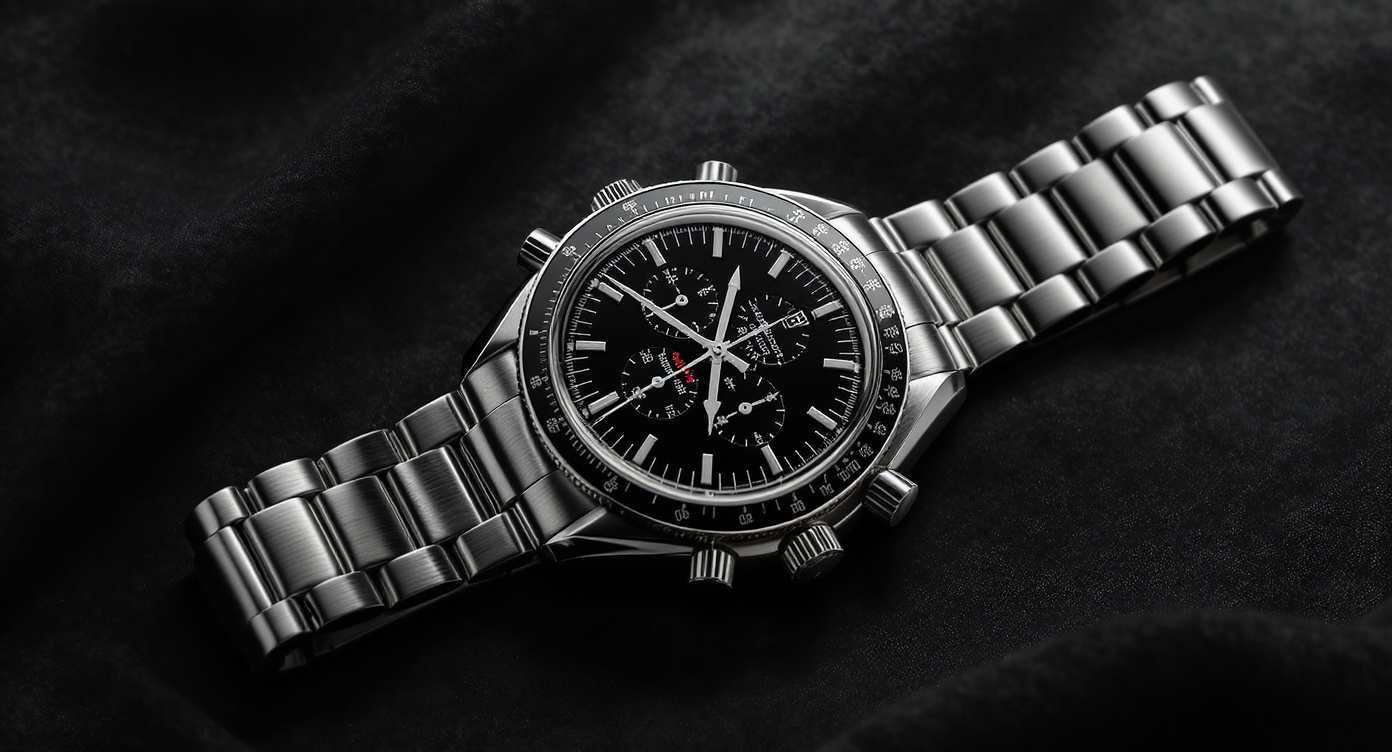
The Omega Speedmaster Moonwatch is the most historically significant wristwatch ever made — NASA-certified, Apollo-tested, and still in production with its most capable movement yet. This 2026 buying guide covers every variant, the hesalite vs sapphire debate, the Calibre 3861 vs 1861 question, current retail prices, and which version to buy based on your priorities.
Prices current as of June 2026. Always verify with an authorised Omega dealer for the latest retail pricing.

A Watch That Went to the Moon — And Never Came Back Down
On 1 March 1965, NASA officially qualified the Omega Speedmaster for all manned space missions following rigorous testing against 11 other chronograph candidates. The Speedmaster survived extremes of temperature (−18°C to +93°C), humidity, shock, vibration, low pressure, and magnetic fields that eliminated every competitor.
On 20 July 1969, Buzz Aldrin wore his Speedmaster on the lunar surface during Apollo 11 — Neil Armstrong had left his inside the lunar module as a backup timer when the LM’s onboard clock failed. The Speedmaster became, and remains, the first and only watch worn on the moon.
What makes the Speedmaster uniquely compelling in 2026 is that Omega has never abandoned its roots. The 42mm case dimensions, the tachymetre bezel, the black stepped dial — these are essentially unchanged since the reference 105.012 worn by Aldrin. You are buying a direct design descendant of a piece of human history, at a price point that sits remarkably close to its pre-owned value.
Current Speedmaster Moonwatch Models in 2026
Omega offers the Moonwatch in four principal configurations in 2026, distinguished by crystal type, movement, and caseback treatment. Here is the full matrix:
| Reference | Crystal | Caseback | Movement | 2026 Retail (USD) |
|---|---|---|---|---|
| 311.30.42.30.01.005 | Hesalite (acrylic) | Solid (engraved) | Calibre 1861 | ~$6,800 |
| 310.30.42.50.01.001 | Hesalite (acrylic) | Solid (engraved) | Calibre 3861 | ~$7,200 |
| 310.30.42.50.01.002 | Sapphire | Exhibition | Calibre 3861 | ~$7,700 |
| 310.20.42.50.01.001 | Sapphire | Exhibition | Calibre 3861 | ~$8,100 |
* Retail prices approximate as of June 2026. Last row features black ceramic bezel. Source: Omega boutiques, WatchCharts June 2026.
The 42mm case in 316L stainless steel is consistent across all variants. Case thickness is 13.5mm for the hesalite models and 14.3mm for the sapphire/exhibition versions due to the domed sapphire crystal profile. Lug-to-lug is 47mm. The brushed and polished bracelet is a five-link design with a folding clasp.
Hesalite vs Sapphire Crystal: The Key Decision
No single choice divides Speedmaster buyers more sharply than the crystal. This is not merely an aesthetic question — it involves movement specifications, caseback type, and philosophical alignment with the watch’s heritage.

The Case for Hesalite
Authenticity: Every Speedmaster worn on every Apollo mission used a hesalite crystal. The acrylic dome produces a characteristic warm, slightly magnified view of the dial that defines how the watch has looked since 1965. No sapphire version has ever been to the moon.
Repairability: Hesalite scratches — but scratches can be polished out in minutes with Polywatch acrylic polish, leaving the crystal looking new. A scratched sapphire crystal must be professionally replaced, typically costing $150–$300 at an Omega service centre.
Caseback: The solid caseback features the iconic Seahorse medallion and Apollo XI commemorative engravings. For many collectors, this is the correct presentation.
Price: The hesalite/Cal. 1861 variant (ref. 311.30.42.30.01.005) is approximately $700–$900 cheaper than the sapphire/Cal. 3861 equivalent.
The Case for Sapphire
Durability: Sapphire rates 9 on the Mohs hardness scale versus roughly 7 for hesalite. Daily wear produces far fewer visible marks, and the crystal will retain its clarity for years without polishing.
Exhibition caseback: The sapphire variants feature an open caseback revealing the Calibre 3861 — a genuinely impressive movement to observe. The bridges, Geneva stripes, and Co-Axial escapement are all visible.
Movement: The sapphire models come exclusively with the newer Calibre 3861, which offers Master Chronometer certification, antimagnetic performance to 15,000 gauss, and +0/−2 seconds per day accuracy — a meaningful improvement over the 1861.
Calibre 3861 vs Calibre 1861: What Actually Changed

The Calibre 1861 has powered the Moonwatch since 1968, itself an evolution of the legendary hand-wound column-wheel cal. 321 used in the earliest Speedmasters. It is a proven, repairable, and historically correct movement. The Calibre 3861, introduced in the 2021 reference update, represents Omega’s most significant Speedmaster movement upgrade in over 50 years.
| Feature | Calibre 1861 | Calibre 3861 |
|---|---|---|
| Certification | COSC Chronometer | METAS Master Chronometer |
| Accuracy | −4/+6 sec/day | +0/−2 sec/day |
| Magnetic resistance | Standard | 15,000 gauss |
| Power reserve | 48 hours | 50 hours |
| Escapement | Standard lever | Co-Axial (3rd generation) |
| Service interval | 5 years recommended | 10 years recommended |
Source: Omega technical specifications, METAS certification data.
In practical terms: if you plan to wear the Speedmaster daily in environments with electronics, motors, or MRI equipment nearby, the 3861’s antimagnetic performance is a meaningful real-world benefit. If you wear it occasionally and value the heritage argument above all, the 1861 is perfectly competent and less expensive to service long-term.
2026 Prices and Value Retention
The Speedmaster occupies an enviable position in the luxury watch market: it is a genuine icon available at retail without significant waitlists (unlike the Rolex Submariner or Daytona), while holding its value better than most competitors in its price band.
As of June 2026, the reference 310.30.42.50.01.002 (sapphire/Cal. 3861) carries an approximate retail price of $7,450–$7,695 from authorised dealers. Secondary market prices on platforms such as Chrono24 and WatchCharts show recent sales of $6,300–$6,700 for lightly pre-owned examples — approximately 88–90% retention at the 2–3 year mark, which is strong for a non-sports Rolex reference.
The hesalite/Cal. 1861 (ref. 311.30.42.30.01.005) retails around $6,800, with pre-owned examples trading between $5,200 and $5,800 — slightly lower retention due to the less desirable crystal and older movement, but still respectable for a watch in this price segment.
Limited edition Speedmasters — the Apollo 11 50th Anniversary, Skywalker GMT, and Racing references — consistently outperform standard models on the secondary market and are worth seeking out if long-term value is a priority. However, these are outside the scope of this standard buying guide.
Which Omega Speedmaster Should You Buy in 2026?
The answer depends almost entirely on how you want to relate to this watch’s history.
Buy the hesalite/Cal. 1861 (ref. 311.30.42.30.01.005) if: You are drawn to the watch precisely because it looks and functions exactly as it did on the moon. You want the most historically authentic version. You are comfortable polishing the crystal and value the lower entry price. This is the watch for purists.
Buy the hesalite/Cal. 3861 (ref. 310.30.42.50.01.001) if: You want the authentic hesalite aesthetic combined with the best movement Omega has ever put in the Moonwatch. This is arguably the best all-round Speedmaster — heritage optics, improved accuracy, 10-year service interval. It costs approximately $400 more than the 1861 version and is worth the premium.
Buy the sapphire/Cal. 3861 (ref. 310.30.42.50.01.002) if: You wear your watches hard, want scratch-resistant clarity that needs no maintenance, and want to watch the movement through the exhibition caseback. This is the most practical daily wearer of the lineup.
For buyers comparing the Speedmaster against alternatives in the same price range — the Tudor Black Bay 58 at roughly $3,900 offers compelling value but lacks the heritage, while the Grand Seiko SBGA211 Snowflake at a similar price point delivers extraordinary finishing but no equivalent history.
Frequently Asked Questions About the Omega Speedmaster Moonwatch
What is the current retail price of the Omega Speedmaster Moonwatch in 2026?
As of June 2026, the Omega Speedmaster Moonwatch ranges from approximately $6,800 (hesalite/Cal. 1861, ref. 311.30.42.30.01.005) to $7,700 (sapphire crystal/Cal. 3861, ref. 310.30.42.50.01.002) at authorised dealers. The black ceramic bezel variant (ref. 310.20.42.50.01.001) sits around $8,100. Secondary market prices run approximately 10–15% below retail for lightly used examples.
Is the Omega Speedmaster Moonwatch still NASA-certified in 2026?
The Omega Speedmaster holds its original NASA qualification status, earned in 1965 for Project Gemini and used through the Apollo programme. Omega continues to supply Speedmasters to NASA for active use. The current references have not undergone separate re-certification testing, but the qualification heritage is intact and relevant.
Hesalite or sapphire — which Speedmaster crystal should I choose?
Choose hesalite if you prioritise historical authenticity, the warm vintage optical character, and the ability to polish out scratches yourself. Choose sapphire if you value scratch resistance, want the exhibition caseback, and prefer not to maintain the crystal. Both are valid choices — the hesalite version is more historically correct, while sapphire is more practical for daily wear.
What is the difference between the Omega Calibre 3861 and Calibre 1861?
The Calibre 3861 (introduced 2021) is a significant upgrade over the 1861: it features METAS Master Chronometer certification (versus COSC), +0/−2 sec/day accuracy (versus −4/+6), antimagnetic performance to 15,000 gauss, a Co-Axial escapement, and a recommended service interval of 10 years versus 5. The 1861 is historically correct and proven over decades; the 3861 is technically superior in every measurable way.
Does the Omega Speedmaster hold its value?
Yes — the Speedmaster Moonwatch holds its value well for a non-Rolex watch in its price range. The sapphire/Cal. 3861 references retain approximately 88–90% of retail value in lightly pre-owned condition based on June 2026 secondary market data from Chrono24 and WatchCharts. Limited edition Speedmasters (Apollo 11 commemoratives, etc.) often trade above retail.
Where is the best place to buy an Omega Speedmaster?
Authorised Omega boutiques and certified jewellers offer full warranty, genuine servicing, and financing options. For pre-owned, Chrono24, WatchBox, and Bob’s Watches are reputable platforms with buyer protection. Avoid private eBay listings for a first purchase — counterfeit Speedmasters exist and require experienced eyes to identify.
More Watch Guides
Rolex Submariner vs Tudor Black Bay 58 (2026)
The definitive dive watch comparison for 2026 — which should you buy?
Grand Seiko Snowflake vs Rolex Submariner: 2026 Buying Guide
Spring Drive precision vs Swiss diving icon — a complete comparison.
Top 10 Best-Selling Rolex Watches 2026
The complete guide to Rolex’s most popular references this year.
Ready to explore more? Browse our full Omega watch guides and buying guides for in-depth reviews across every major Swiss and Japanese watchmaker.
Leave a Reply