
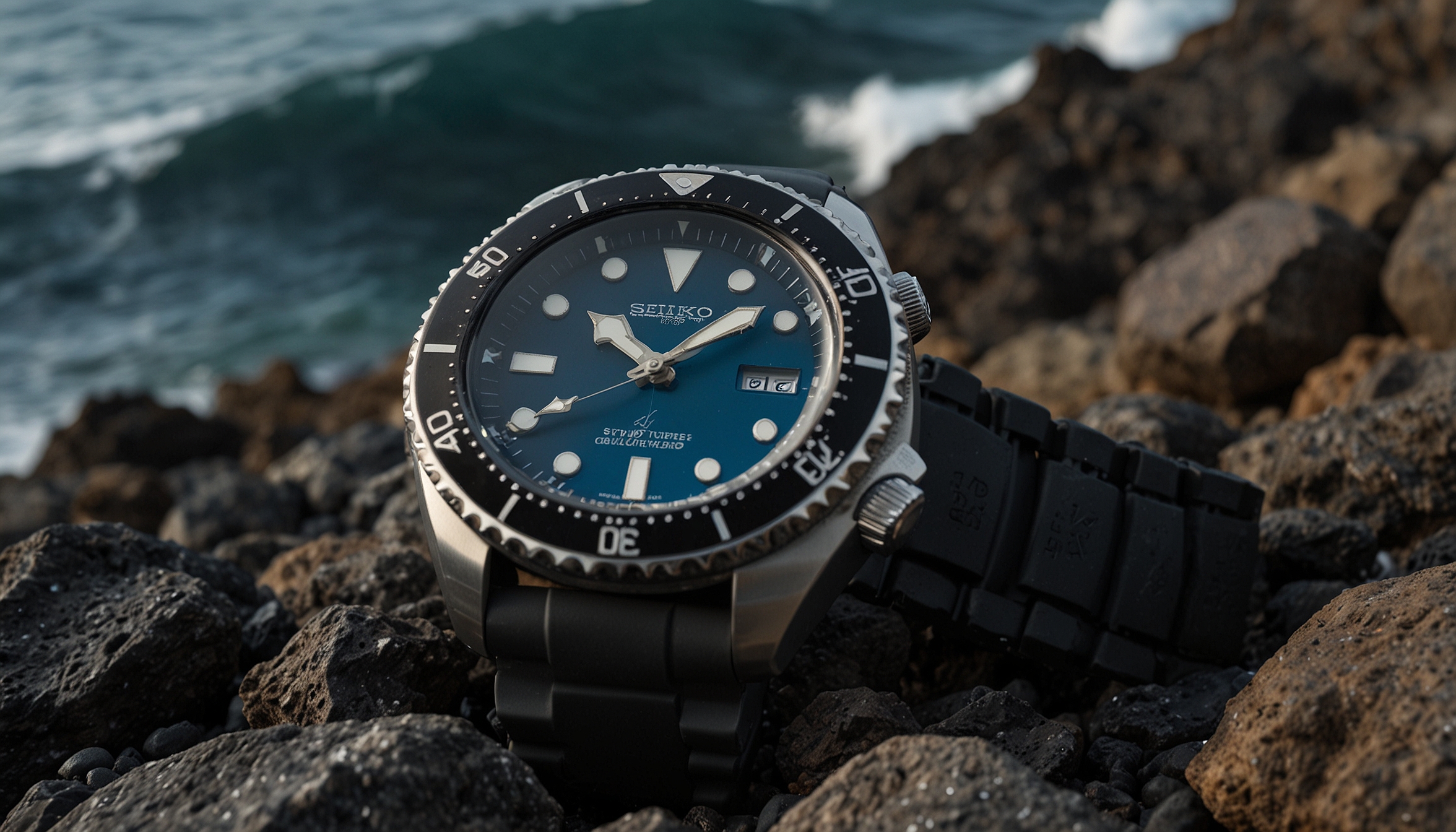
Seiko King Turtle Review: The Best-Value Dive Watch You Can Buy in 2026
The Seiko King Turtle (SRPE03) costs around $475 and delivers 200m water resistance, a self-winding movement, and one of the most distinctive case shapes in diving watches. It outperforms rivals at twice the price on pure specification — and it’s still the dive watch benchmark for value-conscious collectors in 2026.
Disclaimer: Prices referenced are approximate retail values as of June 2026. Always verify current pricing with authorised Seiko dealers before purchasing.
The King Turtle Story: From 1969 to Today
The original “Turtle” name comes from a piece of Seiko folklore. When Seiko’s 1969 ref. 6105 dive watch was reviewed by early collectors, they noted the distinctive cushion-shaped case — rounded at the corners with an almost organic silhouette — and the name “Turtle” stuck informally. The case shape references a tortoise shell viewed from above.
Seiko reissued the concept properly in 2015 with the Prospex SRPC49 (“Baby Turtle”), then escalated in 2018 with the full-size King Turtle in the SRPE03 reference — featuring a larger 45mm case, upgraded 4R36 movement, and enhanced lug design. The “King” designation signals that this is the flagship expression of the Turtle bloodline.
The King Turtle sits within Seiko’s Prospex line, which is the brand’s dedicated sports and professional tool-watch collection. Prospex has produced some of the most important dive watches in history, including the original 1965 Professional Diver 150m — Japan’s first diver’s watch certified to ISO standards.
In 2026 the King Turtle remains in production essentially unchanged from its 2018 debut, a testament to how well the original brief was executed. The black-dial SRPE03K1 and the navy SRPE93K1 are the two primary references you’ll encounter at retail.

Full Specifications: SRPE03 & SRPE93
Before diving into the feel of the watch, here are the hard numbers. The King Turtle ships in two primary dial variants — the black SRPE03 and the navy/blue SRPE93. Both share identical case dimensions, movement, and water resistance.
| Specification | SRPE03K1 (Black) | SRPE93K1 (Navy) |
|---|---|---|
| Case diameter | 45mm | 45mm |
| Case thickness | 13.3mm | 13.3mm |
| Lug-to-lug | ~48mm | ~48mm |
| Lug width | 22mm | 22mm |
| Case material | Stainless steel | Stainless steel |
| Crystal | Hardlex mineral | Hardlex mineral |
| Water resistance | 200m / 660ft (ISO 6425) | 200m / 660ft (ISO 6425) |
| Movement | Seiko Calibre 4R36 | Seiko Calibre 4R36 |
| Power reserve | 41 hours | 41 hours |
| Frequency | 21,600 vph | 21,600 vph |
| Accuracy | +45/-35 sec/day | +45/-35 sec/day |
| Bezel | Unidirectional, 120-click, black | Unidirectional, 120-click, navy |
| Strap | Black silicone rubber, 22mm | Navy silicone rubber, 22mm |
| Retail price (2026) | ~$475 USD | ~$475 USD |
Source: Seiko authorised retailer pricing, June 2026.
Case Design, Dial & Wearability
The King Turtle’s most distinctive feature is its cushion case — a rounded square silhouette with curved sides and abbreviated lugs. It’s an unmistakeable shape that looks nothing like a standard round dive watch. At 45mm with a roughly 48mm lug-to-lug span, it is a large watch on paper, but the cushion geometry distributes weight across a wider area of the wrist than a conventional round case of the same diameter. Most collectors with 7–7.5 inch wrists report it wears smaller than expected.
The finishing on the SRPE03 is a mix of brushed and polished surfaces. The case flanks and lugs are brushed — practical for a tool watch that will encounter hard use — while the case chamfers catch light with a polished finish. For a watch at this price, the quality of the finishing is genuinely impressive.
The black dial features applied Arabic numerals at 12, 6, and 9 o’clock, with baton indices at the remaining hour positions. Everything is generously coated with Seiko’s LumiBrite compound, which charges quickly and holds a strong glow for several hours — important for any legitimate dive watch. The hands are thick, broad, and clearly legible at a glance.
The unidirectional bezel uses 120 clicks for its full rotation, giving you a higher-than-standard click frequency and thus more precise elapsed-time measurement. The bezel insert has a lume dot at 12 o’clock. It has a heavy, deliberate action — good tactile resistance — that matches the serious tool-watch character of the rest of the piece.
One note on the Hardlex crystal: Seiko uses their proprietary Hardlex mineral glass rather than sapphire. Hardlex is more shatter-resistant than sapphire (relevant for actual dive use) but scratches more easily. Many owners fit an aftermarket sapphire crystal for under $50 — a popular and reversible modification that elevates scratch resistance significantly.
Movement: Calibre 4R36 Explained
The Seiko King Turtle runs on the Calibre 4R36 — a 21,600 vph automatic with 41 hours of power reserve, hacking (seconds hand stops when you pull the crown), and manual winding capability. All three functions matter more than they might seem at first glance.
Hacking lets you set the time precisely by stopping the seconds hand, synchronise to a time signal, then release it. For a dive watch, accurate time is a safety consideration. Hand-winding lets you start the watch after it’s been sitting unworn without having to shake your wrist or strap it on mid-morning.
The accuracy spec of +45/-35 seconds per day is honest rather than impressive. In real-world testing by collectors, the 4R36 typically runs +10 to +15 seconds fast per day when cased in the King Turtle — well within ISO 6425 dive watch standards (±15 seconds/day). For buyers requiring sub-5-second accuracy, the Seiko Prospex SPB series with the 6R35 (±15s/day spec) would be a better choice.
What the 4R36 offers is robustness and repairability. It’s a movement that Seiko service centres worldwide know intimately, parts are abundant, and a full service typically costs $100–$150. For a tool watch intended to get wet, scratched, and used, this matters more than COSC-level precision.

On the Wrist: Everyday Wear & Dive Performance
The King Turtle’s 200m water resistance is ISO 6425 certified — tested for pressure, shock resistance, magnetic resistance, and legibility. You can take this watch scuba diving, freediving, or surfing without hesitation.
For everyday wear, the silicone rubber strap is comfortable and practical. It dries instantly after water exposure and is easy to clean. The 13.3mm thickness means the King Turtle sits noticeably above the wrist — typical of 200m divers with screw-down crowns. Under a shirt cuff it’s a snug fit. This is a sport watch at heart.
Wrist presence is significant. The cushion case draws attention — people regularly ask about it. The King Turtle has a visual identity that a round dive watch at this price simply can’t match.

King Turtle vs the Competition
How does the King Turtle stack up against its natural rivals at similar price points?
| Watch | Price (2026) | Water Resistance | Movement | Crystal | ISO 6425 |
|---|---|---|---|---|---|
| Seiko King Turtle SRPE03 | ~$475 | 200m | 4R36 auto | Hardlex | ✅ |
| Orient Mako III | ~$200 | 200m | F6922 auto | Mineral | ❌ |
| Citizen Promaster Diver NY0040 | ~$350 | 200m | 8203 auto | Mineral | ✅ |
| Seiko Prospex SPB143 | ~$550 | 200m | 6R35 auto | Sapphire | ✅ |
| Tudor Black Bay 58 | ~$4,975 | 200m | MT5402 auto | Sapphire | ✅ |
Source: Authorised retailer pricing, June 2026.
The King Turtle’s closest internal rival is the SPB143, which adds a 6R35 movement (70hr power reserve, ±15s/day) and sapphire crystal for roughly $75 more. If those upgrades matter, the SPB143 is the better buy. For the unique cushion case design at the lowest possible price, the King Turtle wins on value.
Versus the Tudor Black Bay 58 — at one-tenth the price, the King Turtle can’t match the Tudor’s finishing or movement quality, nor should it. It’s the answer to: “What’s the best dive watch under $500?”
Verdict: Who Should Buy the Seiko King Turtle?
The Seiko King Turtle SRPE03 makes sense for four types of buyers:
- First-time mechanical dive watch buyers who want genuine specifications — ISO 6425 certification, 200m WR, hack-and-wind automatic — without a four-figure investment.
- Collectors who want a distinctive case shape. The cushion case is genuinely unique in this segment. If you’re tired of round divers, the Turtle is the strongest left-field choice at this price.
- Actual divers who need a certified tool watch for recreational scuba or freediving and don’t want to risk an expensive watch underwater.
- Modders. Aftermarket sapphire crystals, domed crystals, handsets, dials, and custom straps for the King Turtle are all readily available. It’s an excellent platform for personalisation.
At approximately $475, the Seiko King Turtle delivers more dive watch for the money than almost anything else on the market. For context on where it fits in the broader landscape, see our Grand Seiko vs Rolex Submariner comparison for the premium end of the spectrum.
More Watch Reviews & Guides
Omega Speedmaster Moonwatch 2026 Buying Guide
The complete 2026 Omega Speedmaster Moonwatch buying guide — Hesalite vs Sapphire, Cal. 3861 vs 1861…
Rolex Submariner vs Tudor Black Bay 58 (2026)
The Rolex Submariner starts at $10,050 and the Tudor Black Bay 58 at $4,975. Both exceptional dive watches…
Grand Seiko Snowflake vs Rolex Submariner (2026)
A detailed 2026 comparison of the Grand Seiko SBGA211 Snowflake and Rolex Submariner 126610LN…
Ready to explore more? Browse our full Seiko watch reviews or compare options in our dive watch buying guides.
Frequently Asked Questions About the Seiko King Turtle
What is the Seiko King Turtle and what makes it different from the regular Turtle?
The Seiko King Turtle (SRPE03) is a 45mm ISO 6425-certified dive watch in Seiko’s Prospex line, powered by the Calibre 4R36 automatic movement. The “King” designation distinguishes it from the Baby Turtle (SRPC49), which measures 42.3mm. The King Turtle features a larger cushion case, longer lugs, and a heavier wrist presence. Both share the distinctive cushion silhouette that gives the Turtle line its name, tracing back to the legendary 1969 ref. 6105.
Is the Seiko King Turtle good for actual diving?
Yes. The King Turtle carries ISO 6425 dive watch certification, tested for pressure resistance to 200m, luminescence, shock resistance, and magnetic resistance. It is a genuine tool watch suitable for recreational scuba diving and freediving. The unidirectional elapsed-time bezel, generous LumiBrite application, and screw-down crown all meet professional dive watch requirements.
What is the price of the Seiko King Turtle in 2026?
The Seiko King Turtle SRPE03K1 (black dial) and SRPE93K1 (navy dial) retail for approximately $475 USD through authorised Seiko dealers in 2026. Grey market pricing is often 10–20% lower. The watch represents exceptional value given its ISO 6425 certification, automatic movement with hack and wind, and 200m water resistance.
How accurate is the Seiko King Turtle’s movement?
The Calibre 4R36 has an official accuracy specification of +45/-35 seconds per day. In practice, most King Turtles run between +10 and +20 seconds fast per day. This is within ISO 6425 standards (±15 seconds/day) and acceptable for a tool dive watch, though buyers requiring tighter precision should consider the upgraded SPB143 with its 6R35 movement (±15s/day spec, 70hr power reserve).
Can I fit a sapphire crystal on the Seiko King Turtle?
Yes. Aftermarket sapphire crystals for the King Turtle are widely available from suppliers including Dagaz and Crystaltimes, typically for $40–$80 USD. Installation requires a crystal press and moderate watchmaking skill, or can be done by any watch service centre. A sapphire upgrade is one of the most popular modifications for King Turtle owners who find the stock Hardlex scratches too easily in daily use.
What strap options are available for the Seiko King Turtle?
The King Turtle ships on a 22mm rubber strap. The 22mm lug width opens up wide aftermarket options: NATO straps ($15–$40), leather straps ($30–$100), and steel bracelets from brands like Uncle Seiko or Strapcode ($50–$120). Many collectors swap to a dark green NATO for a vintage military aesthetic, or a stainless oyster-style bracelet for a more dressed-up look.
Leave a Reply