
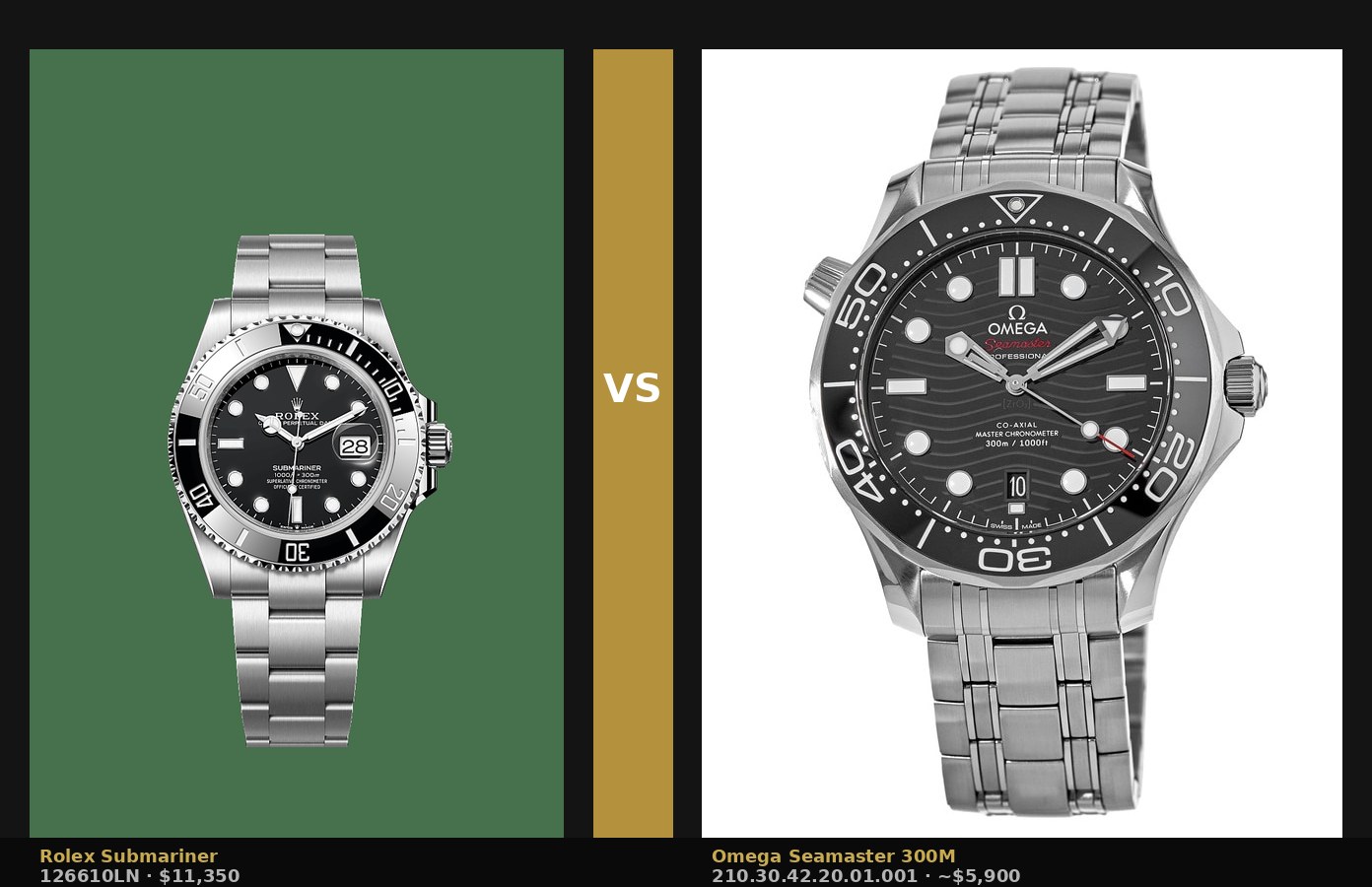
The Rolex Submariner and Omega Seamaster 300M are the two most iconic dive watches in the world — and choosing between them is one of the most genuinely interesting decisions in horology. Both share a 300-metre depth rating, ceramic bezels and undeniable heritage, yet they land at wildly different price points and attract very different buyers. This 2026 guide breaks down every meaningful difference so you can choose with confidence.
Prices and specifications as at August 2026. Always verify with authorised dealers.
- Rolex Submariner 126610LN — 41 mm, Cal. 3235, 70-hr power reserve, $11,350 retail. The prestige benchmark; unmatched brand equity and resale value.
- Omega Seamaster 300M (210.30.42.20.01.001) — 42 mm, Cal. 8800, 55-hr power reserve, ~$5,900 retail. Superior anti-magnetic rating, Master Chronometer certified, significantly more affordable.
- Bottom line: Buy the Submariner for status and investment. Buy the Seamaster for pure watchmaking value per dollar.
Overview: Two Legends, One Decision
Few watch debates are more reliably passionate than Submariner vs Seamaster 300M. The Submariner debuted in 1953 as the world’s first serious diver’s watch; the Seamaster followed a year later. Both evolved into cultural icons — the Sub worn by Steve McQueen, the Seamaster 300M immortalised on the wrist of James Bond from 1995 to the present day.
In 2026, both watches continue to define their respective brands’ identities. The Submariner remains Rolex’s bestselling reference and arguably the most recognisable luxury watch on Earth. The Seamaster 300M — powered by Omega’s Master Chronometer–certified Cal. 8800 — represents arguably the best technical value at its price tier in the entire Swiss dive watch segment.
If you are weighing up these two, you are almost certainly choosing between brand prestige and watchmaking value. Neither choice is wrong. This guide will help you understand exactly what you are getting with each.
Design & Heritage
Rolex Submariner 126610LN
The Submariner’s design language has barely changed since the 1950s, and that is precisely the point. The 41 mm Oystersteel case, the domed sapphire crystal with Cyclops date lens, the syringe “Mercedes” hands, the maxi-dial with its bold Chromalight indices — every detail communicates quiet authority. The Cerachrom ceramic bezel in black is virtually scratchproof and colour-stable for decades. It is a watch that looks expensive without trying.

Omega Seamaster Diver 300M 210.30.42.20.01.001
The Seamaster 300M is the more expressive of the two. Its wave-patterned black ceramic dial is laser-engraved — a detail only visible up close that communicates genuine craft. The skeleton hands, the helium escape valve at 10 o’clock, and the side-alternating brushed and polished links of the bracelet give it a distinctly modern, almost avant-garde energy compared to the Submariner. The blue version with tropical blue ceramic dial is the model’s most famous face, but the all-black reference is just as compelling in person.

Full Specs Comparison
| Specification | Rolex Submariner 126610LN | Omega Seamaster 300M 210.30.42.20.01.001 |
|---|---|---|
| Case Diameter | 41 mm | 42 mm |
| Case Material | Oystersteel (904L) | Stainless steel (316L) |
| Bezel | Black Cerachrom ceramic, unidirectional | Black ceramic, unidirectional |
| Dial | Black, maxi-dial Chromalight | Black ceramic, laser-engraved waves |
| Crystal | Sapphire, Cyclops date lens | Sapphire, anti-reflective both sides |
| Water Resistance | 300 m / 1,000 ft | 300 m / 1,000 ft |
| Movement | Cal. 3235 (Manufacture Rolex) | Cal. 8800 (Manufacture Omega) |
| Certification | COSC + Superlative Chronometer (±2 s/day) | METAS Master Chronometer (0–15,000 gauss) |
| Power Reserve | ~70 hours | ~55 hours |
| Anti-magnetic | Up to ~1,000 gauss (Parachrom hairspring) | Up to 15,000 gauss |
| Bracelet | Oyster with Glidelock clasp | Steel with folding clasp |
| 2026 Retail (USD) | $11,350 | ~$5,900 |
| Secondary Market | $14,000–$16,500 | $4,000–$5,200 |
| Lug Width | 20 mm | 20 mm |
Movement & Technical Performance
Rolex Calibre 3235
The Cal. 3235 is one of the most refined movements in production watchmaking. Its bidirectional self-winding Perpetual rotor, the paramagnetic blue Parachrom hairspring, and the Paraflex shock absorbers combine to deliver a remarkable ±2 seconds per day accuracy guarantee — tighter than COSC. The 70-hour power reserve means you can take the watch off for a long weekend and it will still be running on Monday morning. Servicing intervals are typically 10 years for modern-era Rolex movements, reducing long-term ownership costs.
The Rolex movement is also extraordinarily well-finished for a high-volume production watch, with Geneva-striped bridges and a blued rotor — though you’ll only see this with a caseback tool, since the Sub uses a solid screwdown caseback.
Omega Calibre 8800
Omega’s Cal. 8800 is a genuine technical statement. Its METAS Master Chronometer certification is arguably the most demanding accuracy and magnetic resistance standard in modern watchmaking: tested in 8 positions, at varying power reserve levels, and exposed to magnetic fields of 15,000 gauss. The co-axial escapement reduces friction significantly, cutting required service frequency — Omega quotes 8-year intervals for modern movements. The Seamaster’s caseback is display glass, so you can admire the decorated movement architecture directly.
On anti-magnetism, the Seamaster has a substantial edge: 15,000 gauss versus approximately 1,000 gauss for the Submariner. In most everyday situations, this rarely matters. For frequent flyers or those who work near electrical equipment, it is a genuine advantage.
Case Size & Wearability
At 41 mm, the Submariner sits in the sweet spot for most wrists — it is slightly slimmer in profile than the Seamaster’s 42 mm case, and historically has been the reference point against which modern sport watches are measured. On a standard 7-inch wrist, the Submariner wears ideally proportioned.
The Seamaster’s 42 mm is the larger watch, with a slightly more pronounced crown and lug-to-lug measurement of approximately 48.5 mm. Buyers with larger wrists often prefer it; those with slimmer wrists sometimes find it a touch oversized. The difference is subtle in person.
Both use 20 mm lug width — a significant advantage, as the strap and bracelet aftermarket for 20 mm is enormous. You can fit NATO straps, rubber dive straps and elegant leather alternatives on both watches without modification.
The Submariner’s Glidelock clasp allows 20 micro-adjustments over 25 mm without tools, making it easy to adjust over a wetsuit. Omega’s folding clasp is excellent but less granular in its on-the-fly adjustment.
Price, Availability & Resale Value
This is where the comparison becomes most practical — and most complex.
Rolex Submariner: The Investment Case
At $11,350 USD retail, the 126610LN is not cheap. More importantly, obtaining one at retail is genuinely difficult. Authorised Rolex dealers operate waitlists that can stretch years, and it is not uncommon to find dealers requiring substantial purchase histories before a steel Submariner becomes available. New examples on the Chrono24 secondary market currently fetch $14,000–$16,500 — meaning buyers who secure retail allocation are purchasing below market value from day one. Rolex’s resale retention is legendary; a steel Submariner purchased today will almost certainly hold significant value over a 10-year horizon.
Looking for a reliable pre-owned Rolex Submariner? Shop compatible Submariner straps and accessories on Amazon to personalise your purchase while you wait for retail availability.
Omega Seamaster 300M: The Value Case
The Seamaster retails at approximately $5,900 USD on steel bracelet — roughly half the price of the Submariner. It is also readily available at any authorised Omega boutique, which cannot be overstated as an advantage. You pay the retail price, you walk out with the watch. Pre-owned examples trade in the $4,000–$5,200 range, representing a premium that evaporates more quickly than Rolex’s — but the Seamaster buyer benefits by wearing a genuine manufacture-movement Swiss dive watch for far less capital outlay. You can explore Omega Seamaster rubber and NATO strap options on Amazon to dress the watch down for daily wear.
For dive watch accessories including watch winders that work beautifully with both references, check the selection on Amazon.
Who Should Buy Which?
Buy the Rolex Submariner 126610LN if:
- Brand recognition and status are important to you — no watch signals success more universally.
- You view your watch as a long-term investment or store of value.
- You prefer a slightly more compact 41 mm case.
- Classic, understated design appeals over technical expressiveness.
- You are prepared for the waitlist and the premium price.
Buy the Omega Seamaster 300M if:
- You want the best Swiss dive watch movement your money can buy at this price tier.
- Immediate availability at retail is important.
- You work or travel in environments with magnetic fields.
- A display caseback and more expressive design language appeal to you.
- Budget is a real consideration — the Seamaster leaves meaningful funds for straps, travel, or a second watch.
For a deep dive into each watch individually, see our Rolex Submariner Complete Buying Guide (2026) and our Omega Seamaster 300M Buying Guide (2026).
Frequently Asked Questions
Neither is objectively “better” — they excel in different areas. The Submariner wins on brand prestige, resale value, and classic design. The Seamaster 300M wins on technical specifications per dollar, including Master Chronometer certification, superior anti-magnetic resistance to 15,000 gauss, and a display caseback. Both are exceptional dive watches.
The Rolex Submariner Date 126610LN (steel, black bezel) retails at $11,350 USD in 2026. Secondary market prices for unworn examples typically run $14,000–$16,500 due to high demand and limited retail availability.
The Omega Seamaster Diver 300M in stainless steel with black dial (ref. 210.30.42.20.01.001) retails at approximately $5,900 USD in 2026 and is available at authorised Omega retailers without a waitlist.
Both are highly accurate. The Rolex Cal. 3235 is Superlative Chronometer certified to ±2 sec/day after casing. The Omega Cal. 8800 is METAS Master Chronometer certified to 0–5 sec/day, tested across 8 positions and in magnetic fields up to 15,000 gauss. For everyday purposes, both will keep excellent time.
No — Rolex’s secondary market performance is exceptional and largely unique in the watch world. The Seamaster 300M is a quality watch that holds reasonable value, but the Submariner’s demand-supply imbalance means it typically appreciates in pre-owned markets. If investment return is a priority, the Submariner has the stronger track record.
Both are rated to 300 metres and are fully capable dive instruments. The Seamaster 300M has a slight edge in practical features: a helium escape valve (useful for saturation diving), higher anti-magnetic resistance, and a more prominent crown guard design. For recreational divers, both are more than adequate. For professional or technical diving, the Seamaster’s additional features give it a minor edge.
Buying a steel Submariner at retail in 2026 remains very difficult. Most authorised dealers operate waitlists and tend to prioritise existing customers with purchase history. Pre-owned and secondary market purchases (Chrono24, Watchfinder, Rolex Certified Pre-Owned) are the most accessible routes for many buyers.
Final Verdict
The Rolex Submariner 126610LN is the most iconic watch ever made. If you can obtain one at retail, it is essentially a self-insuring purchase — one that delivers daily wearing pleasure alongside genuine store-of-value properties. The price is high, and the wait is real, but the Submariner earns its legend every time you glance at your wrist.
The Omega Seamaster 300M is, however, the more rational buy on almost every measurable watchmaking metric per dollar. A Master Chronometer–certified manufacture movement, 15,000-gauss anti-magnetic resistance, a wave-engraved ceramic dial, and readily available retail allocation — for roughly half the price of the Submariner. It is one of the outstanding value propositions in Swiss watchmaking, period.
Our verdict: if budget is not a constraint and status matters, choose the Submariner. If you want outstanding watchmaking for your money and to wear it today, choose the Seamaster 300M. Neither decision will leave you dissatisfied.
See also our full Omega Seamaster 300M Review (2026) for a hands-on deep dive into the blue variant.
Related Articles
- Rolex Submariner Complete Buying Guide (2026) — All References, Specs & Prices
- Omega Seamaster Diver 300M Buying Guide (2026) — All References
- Omega Seamaster Diver 300M Review (2026)
- Rolex Sky-Dweller Review (2026): Is It Worth It?
- Tudor Royal Review (2026): The Underrated Luxury Watch
This article was researched with the help of AI. While we strive to keep all information accurate and up to date, there may be errors. If you notice any discrepancies, please contact us.
Leave a Reply
You must be logged in to post a comment.