
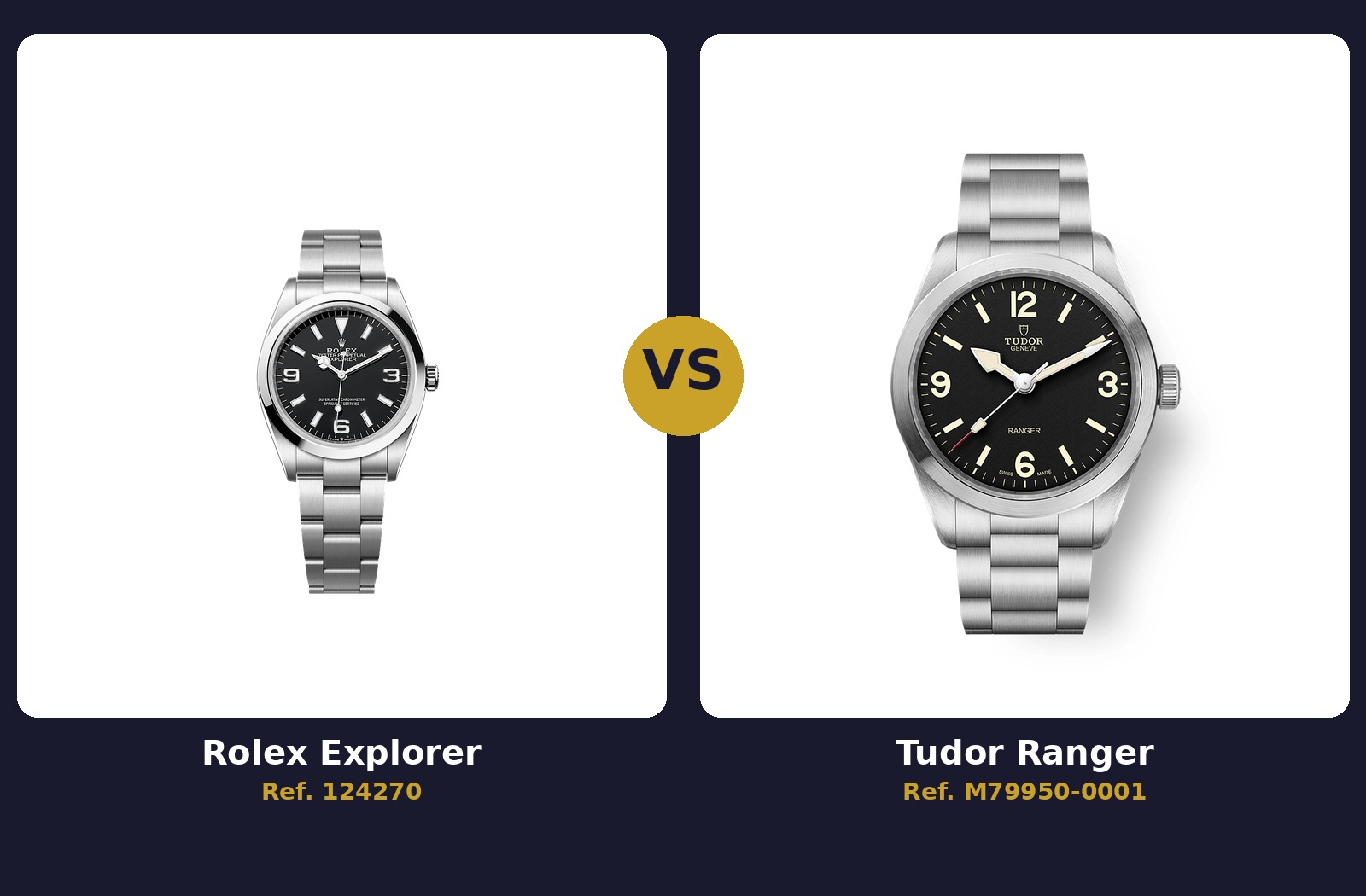
If you want the most recognisable pure “tool” watch in Rolex’s catalogue and don’t mind a real wait to get one, the Rolex Explorer is worth it — but if you want most of the same field-watch DNA, a certified in-house chronometer movement, and nearly $4,000 left over, the Tudor Ranger is the smarter buy for most people. Both are steel, no-nonsense sports watches with roots in 1950s exploration — the Explorer traces back to Everest in 1953, the Ranger to the British North Greenland Expedition of 1952 — and both have become go-to answers in 2026 for anyone who wants a serious watch that doesn’t shout about it.
Prices and specifications as at August 2026. Always verify with authorised dealers.
- Rolex Explorer (ref. 124270): $7,900 retail, 36mm Oystersteel case, in-house Calibre 3230, 100m water resistance, ~70-hour power reserve.
- Tudor Ranger (ref. M79950-0001): $4,025 retail (bracelet), 39mm steel case, Manufacture Calibre MT5402 (COSC), 100m water resistance, ~70-hour power reserve.
- Bottom line: Explorer wins on brand cachet, in-house pedigree, and resale liquidity; Ranger wins on value, wrist presence, and being available without an allocation waitlist.
- Rolex Explorer vs Tudor Ranger: Quick Comparison Table
- Rolex Explorer 124270: Overview
- Tudor Ranger 79950: Overview
- Case Size and Wearability
- Movement and Accuracy
- Price, Value and Resale
- Which Should You Buy?
- Final Verdict
- Frequently Asked Questions
- Related Articles

1. Rolex Explorer vs Tudor Ranger: Quick Comparison Table
| Spec | Rolex Explorer (124270) | Tudor Ranger (M79950-0001) |
|---|---|---|
| Case diameter | 36mm | 39mm |
| Case thickness | ~11.5mm | 12.0mm |
| Case material | Oystersteel (904L) | Satin-finished stainless steel |
| Bezel | Smooth Oystersteel | Smooth satin-brushed steel |
| Movement | Calibre 3230 (in-house) | Manufacture Calibre MT5402 (in-house) |
| Certification | Superlative Chronometer (-2/+2 sec/day) | COSC chronometer (-4/+6 sec/day) |
| Power reserve | ~70 hours | ~70 hours |
| Water resistance | 100m / 330ft | 100m / 330ft |
| Bracelet | Oyster, Oysterlock clasp + Easylink | 3-link steel, T-fit clasp |
| Retail price (2026) | $7,900 | $4,025 (bracelet) |
2. Rolex Explorer 124270: Overview
The Explorer traces its name to 1953, when Rolex watches accompanied Sir Edmund Hillary and Tenzing Norgay’s first ascent of Everest, and the current reference 124270 has carried that no-nonsense identity since 2021. It’s built around a 36mm Oystersteel case with a smooth bezel, a monobloc middle case for extra rigidity, and the same black dial layout the model has worn for decades — oversized 3, 6 and 9 numerals filled with Chromalight material that glows a long-lasting blue in the dark. Inside is the Calibre 3230, Rolex’s fully in-house automatic movement with a paramagnetic blue Parachrom hairspring, Paraflex shock absorbers, and roughly 70 hours of power reserve.
Retail is $7,900 as of the 2026 price list, and while the Explorer isn’t as allocation-starved as a Submariner or Daytona, unworn examples at many authorised dealers still require a purchase history or a modest wait — and the model routinely commands a small premium over retail on the secondary market as a result.
Rolex Explorer 40 (224270)
For buyers who want a bit more wrist presence, the 40mm Explorer (ref. 224270) runs the same Calibre 3230 in a case scaled up from the classic 36mm proportions, and retails for $8,350 — $450 more than the 36mm model, with a similar allocation situation at dealers.

3. Tudor Ranger 79950: Overview
The modern Ranger revives a name Tudor first used in 1965, worn by the British North Greenland Expedition team, and the current reference 79950 relaunched the line in 2022 with a genuine in-house manufacture movement for the first time. The 39mm steel case has a satin-brushed finish throughout, a smooth fixed bezel, a domed sapphire crystal over a matching domed black dial, and painted Arabic numerals at 3, 6, 9 and 12 with beige lume — a deliberately vintage, tool-watch look. The screw-down crown carries the Tudor rose in relief, and the steel bracelet uses Tudor’s “T-fit” folding clasp for quick on-the-fly adjustment.
Powering it is the Manufacture Calibre MT5402, a COSC-certified movement with a silicon balance spring and roughly 70 hours of power reserve — genuinely comparable engineering to Rolex’s in-house calibres at well under half the price. Retail is $4,025 on the steel bracelet, and unlike the Explorer, the Ranger is generally available to order or buy at or close to list price through authorised Tudor dealers.
Tudor Ranger 36mm (M79930)
Tudor also offers a 36mm Ranger (ref. 79930) for smaller wrists, running the same MT5402 movement in a more compact case, priced from $3,550 to $3,900 depending on dial colour and strap choice.

4. Case Size and Wearability
At 36mm and roughly 11.5mm thick, the Explorer 124270 is one of the trimmer sports Rolex models — it sits close to the wrist and slips under a shirt cuff easily, which is part of why it’s such a popular “one watch” recommendation. The Ranger’s 39mm case is noticeably larger on paper, but its 12.0mm thickness and relatively short lug-to-lug keep it from wearing as large as the number suggests, so most wrists from about 6 to 7.5 inches will find it comfortable.
If you have a smaller wrist and want the most classically proportioned field watch, the 36mm Explorer (or the 36mm Ranger, for that matter) is the safer choice. If you prefer a bit more dial presence without stepping up to a 40mm sports watch, the 39mm Ranger hits a sweet spot that’s become one of the most requested sizes in the category.
5. Movement and Accuracy
Both watches are powered by fully in-house, COSC-adjacent movements built around silicon or paramagnetic hairsprings, and both comfortably beat COSC’s already-tight -4/+6 seconds/day chronometer standard in practice. Rolex certifies the Calibre 3230 as a Superlative Chronometer, meaning -2/+2 seconds/day after casing — a tighter published spec than Tudor’s straight COSC certification for the MT5402. In real-world ownership reports, though, MT5402-equipped watches frequently land in the same +2 to +4 seconds/day range as their Rolex counterparts.
In short: you’re not buying meaningfully better daily timekeeping when you spend nearly double on the Explorer. You’re buying a tighter official spec on paper, a longer track record, and — for now — a stronger resale floor.
6. Price, Value and Resale
At $7,900, the Explorer costs almost double the Ranger’s $4,025 bracelet price, and that gap can widen further on the secondary market: because the Explorer still sees some allocation friction at dealers, unworn examples occasionally trade at a modest premium over retail. The Ranger, by contrast, is one of the easier modern Tudors to simply walk in and buy, and pre-owned prices tend to sit close to or modestly under retail depending on condition and completeness.
That makes the Explorer the better “store of value” purchase in the narrow sense that it has historically held its retail price better — but a meaningful part of that gap reflects brand equity rather than better engineering. The Ranger is the better value purchase in a more practical sense: a genuinely excellent in-house COSC movement, a compelling vintage-inspired design, and thousands of dollars back in your pocket.
7. Which Should You Buy?
Buy the Explorer if: you want the strongest brand recognition and resale liquidity, you’re building a long-term collection where a Rolex anchors the safe, you value the Explorer’s uninterrupted lineage back to the 1953 Everest expedition, or you simply prefer the tighter -2/+2 sec/day chronometer spec.
Buy the Ranger if: you want the best field-watch value in Switzerland today, you’d rather have a genuinely in-house COSC movement and cash left over for a second watch, you like the more overtly vintage dial and bezel treatment, or you don’t want to navigate allocation games at an authorised dealer.
8. Final Verdict
Neither watch is the “wrong” choice, which is exactly why this comparison keeps coming up. The Rolex Explorer remains the reference point for the no-date, do-everything steel sports watch — it’s the watch this entire category still gets measured against more than 70 years after it first went up Everest. If budget is a secondary concern and you want the crown on the dial, buy the Rolex and don’t overthink it.
But if you’re weighing genuine day-to-day value, an equally serious in-house movement, and not wanting to wait on a list, the Tudor Ranger is, in our view, the more rational purchase for most buyers in 2026. It’s the watch we’d point a friend toward if they wanted an Explorer-style watch without the Explorer-style waitlist.
9. Frequently Asked Questions
Is the Tudor Ranger as good as the Rolex Explorer?
Why is the Rolex Explorer so much more expensive than the Tudor Ranger?
Does Tudor own Rolex, or are they related companies?
Which watch is easier to buy at retail in 2026?
What size wrist suits the Ranger vs the Explorer?
Does either watch have a date window?
Is the Tudor Ranger a good first serious watch?
Gearing Up With Your New Field Watch
Whichever you choose, a few accessories are worth budgeting for alongside the watch itself. A quality automatic watch winder keeps a self-winding movement like the 3230 or MT5402 ready to wear if you rotate between watches. A rugged 20mm canvas or NATO strap is a cheap way to lean further into the field-watch look on either model without committing to an aftermarket bracelet. And a padded watch travel case is worth having if you’re taking either watch on an actual outdoor trip.
10. Related Articles
- More Rolex buying guides and reviews on The Watchology
- More Tudor buying guides and reviews on The Watchology
- Rolex Explorer Buying Guide 2026: All References, Specs & Prices
- Tudor Ranger 79950 Review (2026): The Best-Value In-House Field Watch?
- Tudor vs Rolex: Which Brand Is Better Value in 2026?
Recent Articles
- Seiko Presage Sharp Edged SPB225 vs SPB331 (2026)
- Seiko Astron GPS Solar Review (2026)
- Rolex Daytona 126500LN vs Omega Speedmaster Professional Moonwatch (2026)
This article was researched with the help of AI. While we strive to keep all information accurate and up to date, there may be errors. If you notice any discrepancies, please contact us.
Leave a Reply
You must be logged in to post a comment.