
Grand Seiko and Omega are the two most technically credible luxury watch brands outside the Rolex ecosystem — yet they represent almost opposite philosophies, and the choice between them says more about your values than your budget. Both are available without a waitlist, both sit in the $5,000–$9,000 sweet spot for their flagship steel references, and both build genuinely excellent in-house movements. But Grand Seiko is a meditation on Japanese craft tradition, while Omega is a 178-year-old Swiss manufacture with moonshots on its résumé.
Prices and specifications as at August 2026. Always verify with authorised dealers.
- Choose Grand Seiko if you want unrivalled dial artistry, Zaratsu-polished case finishing that rivals anything in watchmaking, and the revolutionary Spring Drive movement accurate to ±15 seconds per month — at roughly the same price as a comparable Omega.
- Choose Omega if you want 178 years of Swiss heritage, METAS Master Chronometer certification, 15,000-gauss antimagnetic protection, and a brand recognisable from Tokyo to Toronto.
- Price range: Grand Seiko from $4,000 (SBGW231) | Omega from ~$2,900 (DeVille quartz) — both brands meet at $6,700–$6,900 for their most popular steel references.
- Resale: Both depreciate 25–35% below retail on the secondary market. Neither matches Rolex for investment value.

Brand Heritage: 1960 vs 1848
Omega was founded in 1848 by Louis Brandt in La Chaux-de-Fonds, Switzerland, making it one of the oldest continuously operating watch manufacturers in the world. By the late 19th century the brand had industrialised its production to a degree that was revolutionary for Swiss watchmaking. The 20th century added layer after layer of heritage: Official Timekeeper at the Olympics, the Marine Chronometer that helped establish maritime time standards, and most memorably, the Speedmaster becoming the first watch worn on the Moon in 1969. When Omega talks about history, it has a century and a half of verifiable, world-changing moments to draw from.
Grand Seiko’s story is shorter and more concentrated. Seiko — its parent company — was founded in 1881, but the Grand Seiko name was created in 1960 with a specific purpose: to build the finest watch in the world by Seiko’s own hand. The original 1960 reference met or exceeded Swiss chronometer standards and announced Japan’s arrival as a serious force in precision timekeeping. Grand Seiko became an independent brand in 2017, though its watches are still built entirely within the Seiko family — at the Shizukuishi Watch Studio in Iwate Prefecture and the Shinshu Watch Studio in Nagano. Every watch that leaves either atelier carries the specific handwork of the craftspeople there, stamped with regional pride.
Movement Technology Compared
This is where the comparison becomes genuinely interesting, because both brands have made real technological contributions to horology — they just went in different directions.
Grand Seiko: Spring Drive and Hi-Beat 36000
Grand Seiko’s signature contribution is the Spring Drive, invented by Seiko engineer Yoshikazu Akahane after 28 years of development. Spring Drive is neither purely mechanical nor purely electronic — it uses a mainspring as its power source but regulates its timekeeping via a tri-synchro regulator that generates a tiny electromagnetic brake to keep the glide wheel spinning at exactly the right rate. The result is an accuracy of ±1 second per day (±15 seconds per month) — four times more accurate than standard COSC certification — with absolutely zero ticking. The Spring Drive sweeps so smoothly that it appears to move like a quartz watch, yet draws no battery.
For buyers who prefer conventional mechanical movement, Grand Seiko also offers its Hi-Beat 36000 calibres (the 9SA5 in Evolution 9, the 9S85 in Heritage Collection), which beat at 10 beats per second — significantly faster than the 8 bps standard used by most Swiss movements including Rolex. The faster beat rate improves accuracy and reduces the effect of positional errors.
Omega: Co-Axial Master Chronometer
Omega’s answer is the Co-Axial escapement, developed by independent watchmaker George Daniels and acquired by Omega in 1999. The Co-Axial reduces sliding friction at the escapement — the component that traditionally wears fastest — by distributing force across three pallet faces instead of two. This reduces the need for lubricating oils, which in traditional movements degrade over time, and extends service intervals significantly. The modern generation, called Co-Axial Master Chronometer (the calibres 8800, 8900, 3861), adds METAS certification: an independent Swiss laboratory that tests each movement to a stricter-than-COSC standard, certifying accuracy from -0 to +5 seconds per day and verifying that the movement remains accurate in a magnetic field of 15,000 gauss. At that antimagnetic rating, you could rest a Seamaster 300M on an MRI machine and it would continue ticking accurately.
In straight accuracy terms, Grand Seiko’s Spring Drive is more accurate than Omega’s Master Chronometer (±1 s/day vs -0/+5 s/day). But the Omega’s antimagnetic performance and its independently verified certification are genuinely impressive, and for practical daily wear the difference is irrelevant — both are among the most accurate mechanical/electromechanical movements available to consumers.
Finishing & Craftsmanship
Grand Seiko’s case finishing is, by almost universal collector consensus, among the finest in all of watchmaking at any price. The brand’s Zaratsu polishing technique — hand-applied using a rotating tin disc and a slurry of abrasive — creates flat, mirror-polished surfaces with no distortion whatsoever. Hold a Grand Seiko case under light and the polished facets reflect like a mirror while the brushed surfaces remain perfectly matte: the transition between the two is a razor edge. At the $5,000–$7,000 price point, nothing from Switzerland replicates this. Rolex’s finishing is excellent; Omega’s is very good. Grand Seiko’s is exceptional.
Grand Seiko dials deserve their own mention. They are not printed or painted in the conventional sense — they are textured surfaces that capture, diffuse, and reflect light in ways that reward close examination. The Snowflake dial on the SBGA211 is a hand-applied silver plating process that replicates wind-blown snow on a winter morning. The Birch, Seasons, and Lake Suwa dials in the broader collection do the same for other natural phenomena. An Omega dial is beautifully made and perfectly finished, but it is not attempting to do what a Grand Seiko dial does.
Omega’s finishing is precise and consistently executed across a much higher production volume — the brand produces roughly one million watches per year, compared to Grand Seiko’s estimated 10,000–15,000 pieces annually. This difference in scale explains the craft intensity gap, and also means Grand Seiko will always feel like a more rarefied possession on the wrist.
Design Language
Omega designs exist in a Swiss tradition that prizes functionality and elegance in equal measure. The Seamaster family is built around the tool-watch heritage — brushed case sides, a rotating bezel, ceramic or rubber elements that communicate professional intent. The Constellation and De Ville lines take a dress-watch approach, with medallion dials and Griffes (claws) gripping the sapphire crystal. The Speedmaster Professional maintains an almost unchanged design from its 1969 moon mission reference — a deliberate choice that keeps the connection to history alive. Omega’s design is broadly legible to anyone who follows watches, and recognisable to anyone who doesn’t.
Grand Seiko’s design language is Japanese in a way that goes beyond aesthetics. The case shapes reference natural landscapes — the angles of the Evolution 9 collection echo the Shinshu mountain ridgelines visible from the studio where they’re made. The dial textures are derived from seasons, forests, and weather. There’s a quiet confidence in this approach: Grand Seiko watches do not announce themselves. They reveal themselves slowly, over years of daily wear, as the light changes and catches the polishing in new ways. This is a design philosophy aimed at connoisseurs who look down at their wrist and notice something new each time.
Flagship Comparison: Grand Seiko SBGA211 vs Omega Seamaster 300M

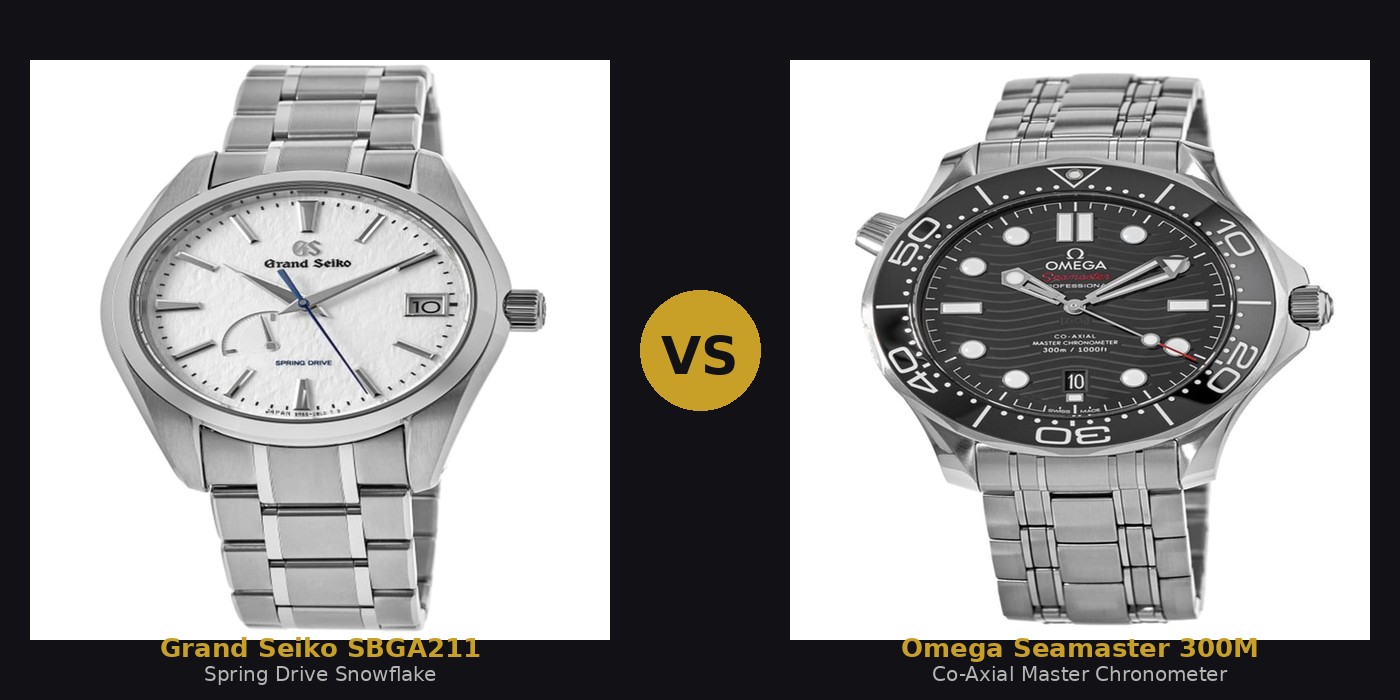
At roughly the same price — the SBGA211 at $6,900 and the Seamaster Diver 300M 210.30.42.20.01.001 at $6,700 — these two watches make the comparison concrete.
The Grand Seiko SBGA211 Snowflake is a 41mm titanium dress-sport watch powered by the Cal. 9R65 Spring Drive, with a 72-hour power reserve and accuracy of ±1 second per day. It weighs dramatically less than a steel watch — titanium is 30% lighter — making it one of the most comfortable large-case watches available at any price. The Snowflake dial’s hand-textured white surface catches light differently at every angle. Water resistance is 100m, which suits the watch’s dress-sport positioning. There is no date window: the only complication is a power-reserve indicator at 6 o’clock.
The Omega Seamaster Diver 300M is a 42mm stainless steel tool watch rated to 300m water resistance, ISO 6425 certified as a proper dive watch, powered by the Cal. 8800 Co-Axial Master Chronometer. Its ceramic uni-directional rotating bezel is essentially unscratchable; its 55-hour power reserve is adequate; its METAS certification means the accuracy, power reserve, and antimagnetic performance are all independently verified. A date window appears at 6 o’clock. On the secondary market, it trades roughly 15–20% below retail, which is better than the Grand Seiko.

Choosing between them is a lifestyle question: the SBGA211 rewards quiet appreciation and daily discovery; the Seamaster rewards confident functionality and global recognition. One is art you wear; the other is equipment you happen to wear very well.
Price Range & Value
Grand Seiko’s current entry point is approximately $4,000 for the SBGW231, a 37.3mm hand-wound dress watch in steel. From there the range climbs steadily through Spring Drive references in titanium and steel ($5,800–$9,800), Hi-Beat Evolution 9 models ($9,800–$14,700), and into limited editions that approach $50,000. The Spring Drive technology costs more than equivalent Hi-Beat calibres — the R&D investment for 28 years of development doesn’t disappear from the price sheet — but at $6,900 for the SBGA211 the value is exceptional relative to Swiss watches at the same price.
Omega’s range is wider. Dress watches (De Ville, Constellation) start around $2,900. The Seamaster family, which includes the 300M, Planet Ocean, and Aqua Terra, runs from $5,200 to $12,000 in steel. The Speedmaster Professional Moonwatch sits at $6,800. Omega’s broader catalogue and higher production volume mean you’re more likely to find exactly the complication, case size, and dial configuration you want — Grand Seiko’s range, while growing, is still narrower.
Resale & Secondary Market
Neither Grand Seiko nor Omega is a Rolex. Both depreciate — typically 25–35% below retail on Chrono24 within a few years of purchase — and neither should be bought primarily as a financial instrument. That said, there are nuances worth knowing.
Omega’s broader brand recognition means demand for its watches is more global. A Seamaster 300M or Speedmaster will sell quickly anywhere in the world; there is no geography where Omega is unfamiliar. Grand Seiko’s collector community is growing fast in the US and Europe, but it remains more concentrated in Japan and among dedicated watch enthusiasts. This affects liquidity on the secondary market: an Omega sells faster; a Grand Seiko may take longer to find the right buyer, even at a fair price.
On the positive side for Grand Seiko, iconic references like the SBGA211 Snowflake have shown relative price stability on the secondary market — demand among collectors has held steady even as the broader pre-owned market softened in 2024–2025. Limited editions and seasonal models from Grand Seiko, particularly the annual White Snowflake releases, occasionally hold or exceed retail at auction.
Which Brand Is Right for You?
Choose Grand Seiko if: You prioritise finishing quality above everything else. You want a watch that becomes more beautiful the longer you own it, not less. You’re drawn to Japan’s craft traditions and want something genuinely unusual — in a dinner or business setting, a Grand Seiko generates more interesting conversations than an Omega. You want the Spring Drive’s mechanical poetry: a movement that sweeps like quartz, feels like fine watchmaking, and is more accurate than almost anything else you can wear. You’re comfortable with a smaller resale market.
Choose Omega if: You want the breadth of choice that 178 years of design history provides. You want METAS-certified antimagnetic performance, or a tool watch with genuine dive credentials (the Seamaster 300M at 300m). You travel internationally and want a watch that needs no explanation — Omega is universally understood. You want a longer service history and global AD network for servicing. You may value resale liquidity slightly more.
SBGA211 Snowflake vs Seamaster 300M: Side-by-Side
| Feature | Grand Seiko SBGA211 | Omega Seamaster 300M |
|---|---|---|
| Reference | SBGA211G | 210.30.42.20.01.001 |
| Retail Price | $6,900 | $6,700 |
| Case Size | 41mm | 42mm |
| Case Material | High-intensity titanium | Stainless steel |
| Thickness | 12.5mm | 13.6mm |
| Movement | Cal. 9R65 Spring Drive | Cal. 8800 Co-Axial MChr |
| Accuracy | ±1 sec/day (±15 s/month) | -0/+5 sec/day (METAS) |
| Power Reserve | 72 hours | 55 hours |
| Water Resistance | 100m | 300m (ISO 6425) |
| Antimagnetic | Standard | 15,000 gauss (METAS) |
| Bezel | Fixed (dress) | Uni-directional ceramic |
| Certification | Grand Seiko in-house | METAS Master Chronometer |
| Secondary Mkt | $4,500–$5,500 (pre-owned) | $4,200–$5,200 (pre-owned) |
Final Verdict
Grand Seiko and Omega are both exceptional and both correct answers, just to different questions. If craftsmanship is your north star — if you want the most beautifully finished case and the most technically elegant movement at $6,000–$7,000 — Grand Seiko wins. The SBGA211 Snowflake, in particular, is a masterpiece that justifies its price through sheer artistry rather than brand equity. If heritage, brand recognition, dive credentials, and a broader model range matter more, Omega wins — and the Seamaster 300M, the Speedmaster Professional, and the Aqua Terra represent different facets of Swiss watchmaking excellence at comparable money.
The most important thing to understand is that neither brand competes with the other in the way Rolex dominates both of them on resale value. Buy Grand Seiko or Omega because you love the watch, not because you’re making a financial bet — and on that basis, both are excellent choices.
Frequently Asked Questions
Is Grand Seiko better than Omega?
Which holds its value better: Grand Seiko or Omega?
Is Grand Seiko worth the money compared to Omega?
How accurate is Grand Seiko’s Spring Drive compared to Omega’s Master Chronometer?
What is the Grand Seiko equivalent to the Omega Seamaster?
Is Grand Seiko recognised outside Japan?
Can I service a Grand Seiko or Omega anywhere in the world?
Related Articles
If you found this comparison useful, these TWG guides cover both brands in depth:
- Grand Seiko Spring Drive Buying Guide 2026
- Grand Seiko Snowflake SBGA211 Review 2026
- Grand Seiko Evolution 9 Collection Buying Guide 2026
- Omega Seamaster Diver 300M Buying Guide 2026
- Omega Seamaster Planet Ocean 600M Review 2026
- Rolex vs Omega (2026): The Ultimate Brand Comparison
- Grand Seiko vs Tudor (2026)
- Grand Seiko vs Panerai (2026)
This article was researched with the help of AI. While we strive to keep all information accurate and up to date, there may be errors. If you notice any discrepancies, please contact us.
Leave a Reply
You must be logged in to post a comment.