
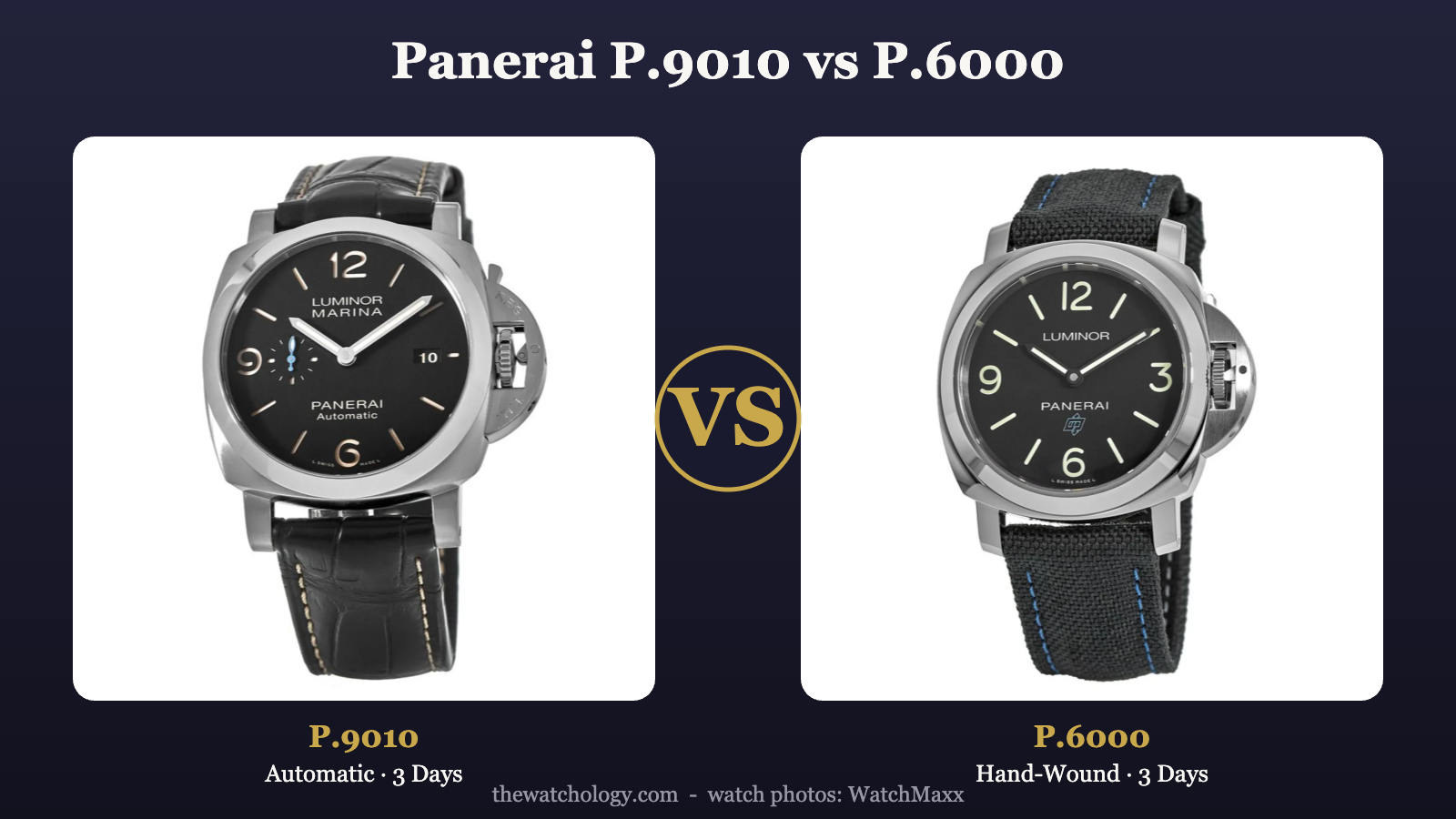
The choice between Panerai’s P.9010 and P.6000 calibres is really a choice between automatic convenience and hand-wound purity — and it shapes which Panerai is right for you. Both are in-house movements with a three-day power reserve, but the P.9010 winds itself while the P.6000 must be wound by hand. This guide explains the real-world differences and which movement suits your wrist.
Prices and specifications as at June 2026. Always verify with authorised dealers or trusted sellers.

TL;DR — P.9010 vs P.6000
Both are in-house Panerai movements with a three-day (72-hour) power reserve. The P.9010 is automatic (self-winding), beats at 28,800 vph, has a small-seconds and date, and often sits behind a display caseback — the convenient, feature-rich choice. The P.6000 is hand-wound, beats at 21,600 vph, is simpler and slimmer, and keeps the watch more traditional. Choose the P.9010 for set-and-forget convenience and a date; choose the P.6000 for hand-wound ritual, slimness and a purer two-hand watch.
Table of Contents
- Two In-House Movements
- Specifications Side by Side
- Automatic vs Hand-Wound
- Features & Caseback
- Which Watches Use Each
- How to Choose
- Who Should Pick Which?
- Final Verdict
- Frequently Asked Questions
Two In-House Movements
Part of what makes modern Panerai compelling is that the brand manufactures its own movements in-house, and the P.9010 and P.6000 are two of the most common you will encounter. Both deliver the three-day power reserve Panerai is known for, both are robust and serviceable, and both appear across the Luminor range. Yet they create very different ownership experiences. The P.9010 is the automatic workhorse — wind itself through wear, set the date, and go. The P.6000 is the hand-wound option — simpler, slimmer, and tied to Panerai’s traditional, vintage-inspired character.
Understanding the difference matters because the movement often dictates the rest of the watch: whether it has a date, whether the caseback shows the mechanics, and how the watch feels in daily use. You can see the contrast clearly in two references we have compared before — the automatic P.9010 lives in the PAM01312 Luminor Marina, while the hand-wound P.6000 powers the PAM00774 Luminor Base Logo.

Specifications Side by Side
| Specification | P.9010 | P.6000 |
|---|---|---|
| Winding | Automatic (self-winding) | Hand-wound (manual) |
| Frequency | 28,800 vph (4 Hz) | 21,600 vph (3 Hz) |
| Power reserve | 72 hours (3 days) | 72 hours (3 days) |
| Barrels | Two | Two |
| Typical jewels | 28 | 19 |
| Date | Commonly yes | Commonly no |
| Small seconds | Yes | Yes |
| Stop-seconds | Yes | Yes |
| Profile | Slightly thicker (rotor) | Slimmer |
Automatic vs Hand-Wound
This is the heart of the matter. The P.9010 is automatic: a rotor winds the mainspring as you move, so if you wear the watch regularly it stays running, and with a three-day reserve it can survive a couple of days off the wrist. It is the convenient, low-maintenance choice — set it once and largely forget it. The stop-seconds function lets you set the time precisely.
The P.6000 is hand-wound: you turn the crown each day (or every few days) to wind the mainspring. For some buyers this is a chore; for many Panerai enthusiasts it is the entire appeal. Hand-winding connects you to the watch and to Panerai’s traditional, military-inspired heritage, and the absence of a rotor keeps the movement — and therefore the watch — slimmer. The three-day reserve means you do not have to wind it every single day if you do not want to.

Features & Caseback
Beyond winding, the movements often differ in what the watch offers. The P.9010 typically brings a date window and, in many references, a sapphire display caseback so you can admire the rotor and finishing — a feature collectors associate with the “fully featured” Luminor. The P.6000 is more commonly paired with a clean, two-hand dial (no date) and a solid caseback, in keeping with its simpler, more traditional positioning. If seeing the movement matters to you, the P.9010 references are more likely to deliver a display back.
Which Watches Use Each
The P.9010 powers a wide range of automatic Luminors and Submersibles — the PAM01312 Luminor Marina is a classic example, as are many 44mm Marina and Submersible references. The P.6000 is found in entry-level, two-hand Luminors such as the PAM00774 Luminor Base Logo and various Luminor Logo models, where simplicity and a slimmer profile are the goal. So in practice, choosing a movement often means choosing between a feature-rich automatic Luminor and a cleaner, hand-wound one.
How to Choose
Ask yourself two questions. First: do you want a date and the convenience of automatic winding, or do you prefer a clean two-hand dial and the ritual of hand-winding? Second: do you want to see the movement through a display caseback? If you answer “automatic and date” and “yes, show me the movement,” the P.9010 is your calibre. If you answer “hand-wound, clean dial” and “a solid caseback is fine,” the P.6000 is the better fit. Neither is more reliable than the other — both are solid, serviceable in-house Panerai movements.
Who Should Pick Which?
Pick a P.9010 watch if: you want convenience. Automatic winding means the watch keeps running as you wear it, the date is genuinely useful day to day, and many P.9010 references let you admire the movement through a display caseback. It is the easy, feature-rich choice for an everyday Panerai.
Pick a P.6000 watch if: you value tradition and simplicity. Hand-winding is part of the Panerai ritual, the clean two-hand dial is more vintage-faithful, and the slimmer movement makes for a thinner watch. It is the purist’s choice for someone who enjoys engaging with their watch each day.
If you cannot decide, default to a P.9010 reference for everyday ease — then consider a hand-wound P.6000 watch as a second, more characterful Panerai down the line.
Final Verdict
The P.9010 and P.6000 are two excellent in-house movements that create different watches. Choose a P.9010 Panerai for automatic convenience, a date and often a display caseback, or a P.6000 Panerai for hand-wound tradition, a clean dial and a slimmer profile. Both share the signature three-day reserve, so let your taste for convenience versus ritual — and whether you want to see the movement — make the call.
Leave a Reply
You must be logged in to post a comment.