
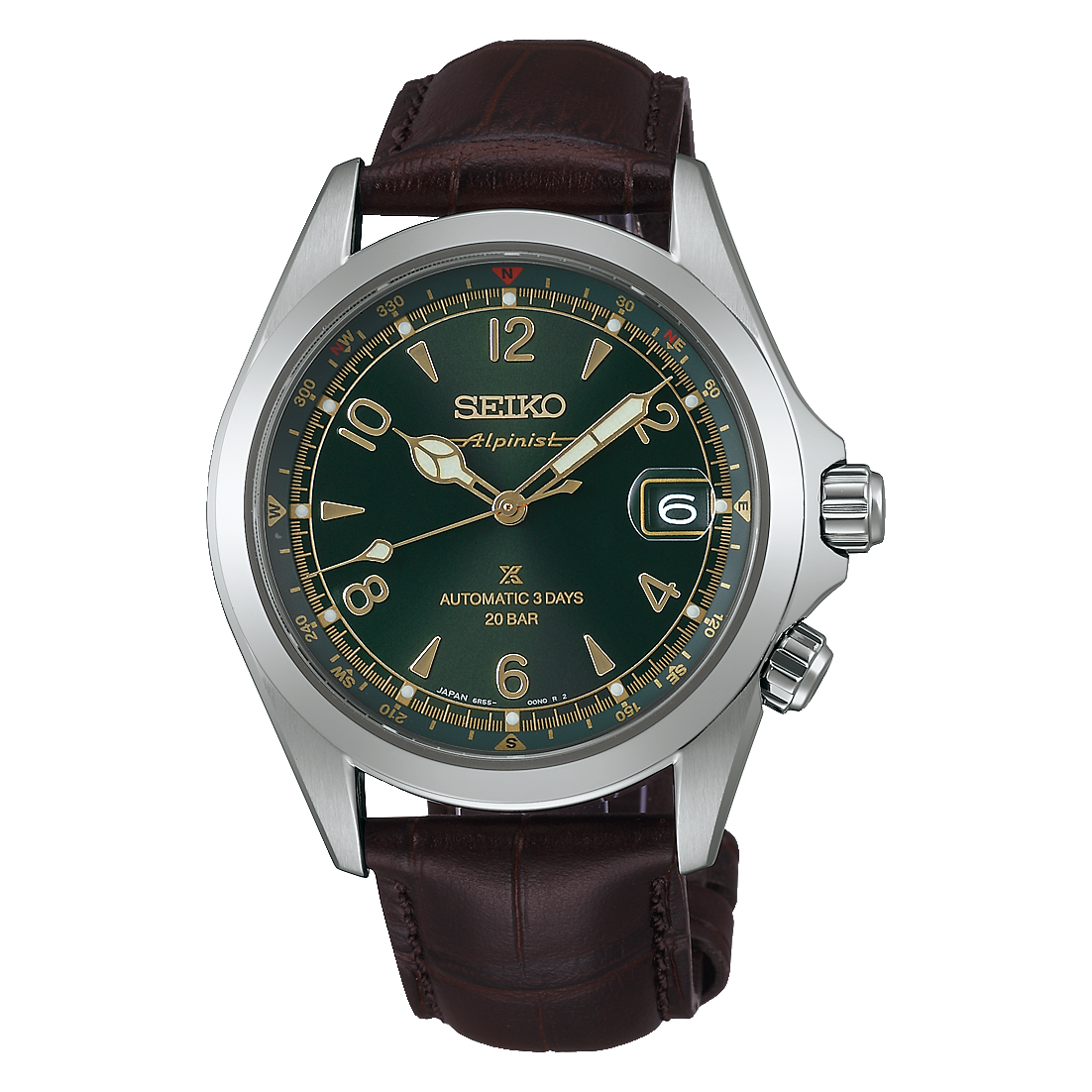
Seiko refreshed the Prospex Alpinist for the first time since 2020, and this eighth generation is the biggest jump the field-and-compass watch has made in years. Three new references — the SPB503, SPB505 and SPB507 — swap in a sapphire caseback, a scratch-resistant Diashield coating and the more refined 6R55 movement, all while nudging the case half a millimetre thinner. If you have been eyeing the Alpinist since the SARB017 days, this is the version to actually buy.
TL;DR: The 2025/2026 Prospex Alpinist refresh (SPB503, SPB505, SPB507) keeps the beloved 39.5mm case and internal compass bezel but adds sapphire front and back, Diashield scratch-resistant coating, and the newer 6R55 movement (72h power reserve, hacking, hand-winding). SPB507 ($900, forest-green dial, leather strap) is the classic look; SPB503 ($995, blue-green dial) and SPB505 ($995, black dial) come on steel bracelets. All three beat the outgoing SPB121 on spec for roughly the same money, and comfortably undercut field-watch rivals like the Tudor Ranger and Longines Spirit.
Table of Contents
A Watch With Real Mountain Heritage
The Alpinist name goes back to 1959, when it was Seiko’s first-ever sports watch, built to go up mountains with Japanese climbers. It disappeared for three decades before returning in 1995 with the case shape, 4 o’clock crown and cathedral hands people now associate with the model. The reference that made it famous was the SARB017 (2006–2017): a green sunburst dial, gold accents and a brown leather strap that became one of the most recommended sub-$500 automatics of the 2010s.
In 2020, Seiko folded the Alpinist into the Prospex line as the SPB range — a watch we’ve reviewed in detail here and covered as part of our broader Seiko Prospex buying guide — and that seventh generation held its ground for five years. Late in 2025, Seiko replaced it with an eighth generation — the SPB503, SPB505 and SPB507 — that finally addresses the two things enthusiasts kept asking for: a sapphire caseback and a movement upgrade.
What’s Actually New in the 8th Generation
The case stays close to the outgoing model’s well-liked proportions — 39.5mm across and 46.4mm lug-to-lug — but drops half a millimetre to 12.7mm thick, and it now wears Seiko’s Diashield coating, a clear hard-ceramic PVD layer that meaningfully cuts down on scratches. Both the front crystal and the caseback are now sapphire; the outgoing SPB121 used sapphire up front but a Hardlex-class window elsewhere on cheaper Prospex models, so this is a genuine upgrade at the price.
Under the caseback sits the Caliber 6R55, a step up from the 6R35 that powered the last generation and a movement that also shows up in some King Seiko pieces. It keeps hacking seconds, hand-winding and a quick-set date, and stretches the power reserve from 70 to 72 hours. The dial gets more faithful to 1995: the date wheel is colour-matched with a gold outline again, and the “Alpinist” script returns in a colour-matched finish rather than the plain printed text used on the outgoing model.
None of it is free — Seiko raised the price roughly A$200 on the leather model and A$300 on the bracelet models compared with the outgoing generation — but on paper, this is a more complete watch for not much more money.
Meet the Three Watches
SPB507 — the classic green
The SPB507 is the one most people picture when they think “Alpinist.” It brings back the dark forest-green dial with gold accents that made the SARB017 famous, mounted on a brown leather strap with a folding clasp. At $900, it’s also the cheapest of the three and the lightest at 88g.
SPB503 — the modern blue-green
The SPB503 trades the traditional green for a blue-green, almost turquoise sunburst dial — a genuinely different look for the Alpinist family — on a three-link steel bracelet with a push-button folding clasp. It’s $995 and 147g on the wrist.
SPB505 — the stealth option
The SPB505 keeps things quiet: a black dial with a subtle brown undertone and white (rather than gold) accents, also on the steel bracelet. Same $995 price and 147g weight as the SPB503, just a more low-key finish for anyone who wants the spec upgrade without the vintage-green look.

Full Specifications
| Spec | SPB503 | SPB505 | SPB507 |
|---|---|---|---|
| Case diameter | 39.5mm | 39.5mm | 39.5mm |
| Thickness | 12.7mm | 12.7mm | 12.7mm |
| Lug-to-lug | 46.4mm | 46.4mm | 46.4mm |
| Lug width | 20mm | 20mm | 20mm |
| Case material | Stainless steel + Diashield coating | Stainless steel + Diashield coating | Stainless steel + Diashield coating |
| Crystal | Sapphire (front & back) | Sapphire (front & back) | Sapphire (front & back) |
| Dial | Blue-green sunburst | Black w/ brown undertone | Forest-green sunburst |
| Strap/bracelet | 3-link steel bracelet | 3-link steel bracelet | Brown leather, folding clasp |
| Weight | 147g | 147g | 88g |
| Movement | Caliber 6R55 | Caliber 6R55 | Caliber 6R55 |
| Power reserve | 72 hours | 72 hours | 72 hours |
| Beat rate | 21,600 vph | 21,600 vph | 21,600 vph |
| Functions | Hours, min, sec, date, hacking, hand-wind, internal compass bezel | Same | Same |
| Water resistance | 200m | 200m | 200m |
| US price (as of July 2026) | $995 | $995 | $900 |
Which One Should You Buy?
- Want the classic look and the lowest price: get the SPB507. It’s the reference photo of an Alpinist, it’s $95–100 cheaper than the other two, and leather is more forgiving in warm climates than a bracelet you can’t resize yourself.
- Want one watch that does bracelet-casual and strap-dressy: get the SPB503 or SPB505 — the steel bracelet is easier to dress up, and both take 20mm straps easily if you want to switch it up (the Alpinist has always been a strap monster).
- Want the most distinctive dial: the SPB503’s blue-green dial is the one nobody else in this price bracket is doing quite like this.
- Want the most versatile everyday colour: the SPB505’s black dial hides scratches and travel dirt better and pairs with literally anything, at the cost of some of the Alpinist’s personality.

Who Should Skip This Watch
If you already own an SPB121 (or an earlier SARB-era Alpinist) purely for wearing rather than collecting, the 8th generation is a nice-to-have, not a must-upgrade — the case dimensions, compass function and overall experience are close enough that most owners won’t feel like they’re missing much day to day. And if you want a dedicated dive watch rather than a field watch that happens to handle water well, Seiko’s own Prospex divers — like the models we compare in our Turtle vs Samurai guide — are the better fit; the Alpinist isn’t ISO 6425 dive-rated.
How It Compares to the Competition
The Alpinist doesn’t really have a direct rival at its exact price — that internal compass bezel and this level of finishing are hard to find under $1,000 — but here’s how it stacks up against the watch it replaces and a few adventure-leaning watches people cross-shop it with, including the Hamilton Khaki Field.
| Watch | Price | Case | Movement | Power reserve | Water resistance |
|---|---|---|---|---|---|
| Seiko Alpinist SPB507 (2026) | $900 | 39.5mm, sapphire f/b | 6R55, hacking/hand-wind | 72h | 200m |
| Seiko Alpinist SPB121 (outgoing) | ~$700 (2026 street) | 39.5mm, sapphire front only | 6R35, hacking/hand-wind | 70h | 200m |
| Hamilton Khaki Field Mechanical | ~$625–745 | 38mm, sapphire | H-50, hand-wind only | 80h | 50m |
| Tudor Ranger | ~$3,150 | 39mm, sapphire | MT5402, hacking/hand-wind, COSC | 70h | 100m |
| Longines Spirit (40mm) | ~$2,700+ | 40mm, sapphire | L888.4, hacking/hand-wind, METAS | 72h | 100m |
The short version: the new Alpinist offers a compass bezel, 200m water resistance and a dual-sapphire case that watches two to three times its price don’t bother with, while the Hamilton undercuts it on price but drops water resistance and hacking seconds. If you want the closest thing to Rolex/Tudor-style in-house finishing for a fraction of the money, the Tudor Ranger and Longines Spirit are the aspirational comparisons — not real alternatives at this budget. For a similarly-priced but very different automatic, our Seiko Presage vs Hamilton Khaki Field comparison covers the dress-watch side of this same conversation.
On the Wrist
The dimensions haven’t changed from the outgoing generation, so this still wears the way the Alpinist always has: compact, no-lug-overhang, comfortable under a jacket cuff. The 0.5mm thinner case is a small change on paper, but combined with the still-domed sapphire it makes the watch sit noticeably lower and less top-heavy than earlier SPB-era Alpinists. Early hands-on coverage from outlets that had the watch on wrist before general release consistently singled out the case thickness reduction and the return of the gold-script dial branding as the two changes that matter most day to day — more than the movement swap, which most owners will never notice unless they check the power-reserve spec sheet.
If you’re coming from a modern dive watch, the Alpinist will feel small and light by comparison — that’s the point. It’s built to disappear under a sleeve, not dominate the wrist, which is also why it remains one of the most commonly recommended watches for people who want one automatic that works in the office and on a trail.

What Reviewers Are Saying
Coverage of this generation has been largely positive, and it tends to split into three camps: the “best Alpinist yet” camp, who point at the sapphire caseback, Diashield coating and 6R55 as overdue, genuine upgrades that finally fix the outgoing generation’s two biggest weak points; the price-conscious camp, who note that a roughly 15–20% price bump (A$200–300 depending on market) is a real jump for a watch that still uses the same case dimensions and a movement finished the same simple way as before; and the dial-purist camp, who are simply glad the italic gold Alpinist script and colour-matched date wheel are back, since those small details are exactly what people loved about the original SARB017 and felt was missing from the plainer 7th-generation dial text.
One general theme worth flagging for anyone comparing notes with other owners: the strap and bracelet on all three references are described as “adequate” rather than a highlight — expect the usual Alpinist community advice to hit within weeks of any purchase, which is to try it on a few 20mm NATO or leather straps before deciding the factory option is the one you’ll keep.
Where to Buy
All three references are available now through authorized Seiko retailers. If you’re picking one up, a couple of accessories are worth having on day one:
- A 20mm NATO strap — the Alpinist is a well-known strap monster, and a canvas NATO is the cheapest way to try a different look on the SPB507 before committing to a leather upgrade.
- A single watch winder — useful if the Alpinist is going into rotation with other automatics rather than being worn daily, so it’s not sitting stopped (and needing a reset of the date and compass bezel) every time you pick it up.
- A jeweler’s loupe — handy for actually appreciating the dial detailing (the gold-outlined date wheel, the applied indices) that Seiko brought back for this generation.
Frequently Asked Questions
They share the same case, movement and specs. The differences are cosmetic: the SPB507 has a forest-green dial on a brown leather strap ($900), while the SPB503 (blue-green dial) and SPB505 (black dial) both come on steel bracelets ($995 each).
For most buyers, yes. The 6R55 movement, Diashield scratch-resistant coating and dual-sapphire construction (front and back, versus sapphire front only on the outgoing model) are genuine upgrades for roughly $200–300 more than the outgoing SPB121 sold for at launch.
The Caliber 6R55, an automatic movement with hacking seconds, hand-winding, a quick-set date and a 72-hour power reserve. It replaces the 6R35 used in the previous generation and is also used in some King Seiko models.
Yes. It has a functional internal rotating compass bezel operated by the crown at 4 o’clock — a signature Alpinist feature carried over unchanged from earlier generations.
The Tudor Ranger costs roughly 3.5x more and adds a COSC-certified in-house movement and a more premium finish, but the Alpinist matches it on water resistance and power reserve and adds a compass bezel the Ranger doesn’t have. They’re not really direct competitors — the Ranger is an aspirational step up, not a like-for-like alternative.
It’s one of the most commonly recommended first automatics in this price range: 200m water resistance, a legible dial, a well-regarded movement, and enough history and community goodwill that resale and parts support are unlikely to be a problem.
The 200m water resistance rating covers swimming, snorkeling and recreational diving. It isn’t ISO 6425 dive-certified like Seiko’s Prospex dive watches (e.g. the Turtle or Samurai), so it’s better thought of as a rugged everyday/field watch that happens to handle water well rather than a dedicated dive tool.
Final Verdict
The eighth-generation Prospex Alpinist is a rare case of a brand fixing the exact things its most engaged customers were asking for: a sapphire caseback, a better movement, and dial details that nod back to the SARB017 people still hunt for on the secondhand market. None of the three references reinvent the watch, and the price increase is real, but at $900–995 you’re getting more watch than the outgoing generation for not much more money — and still a genuinely distinctive one next to anything else in this price bracket. For most buyers, the SPB507’s green dial remains the reference version; the SPB503 and SPB505 exist for anyone who wants the same upgrades in a different package.
Recent Articles
This article was researched with the help of AI. While we strive to keep all information accurate and up to date, there may be errors. If you notice any discrepancies, please contact us.
Leave a Reply
You must be logged in to post a comment.