


Tudor started as Hans Wilsdorf’s plan to sell Rolex quality at a lower price; it ended up building something entirely its own — ten references trace exactly how that happened.
Prices and market data as at October 2026. Always verify with authorised dealers.
TL;DR — Tudor History: Born From Rolex, Built on Its Own
Tudor was registered by Hans Wilsdorf in 1926 as an affordable companion to Rolex — same Oyster cases, cheaper movements. The brand issued Submariners to the US Navy and French Marine Nationale in the 1960s and 1980s, then went quiet before the 2012 revival. The Black Bay and Pelagos relaunched the brand; in-house movements from 2015 made it independent in everything but ownership. Today the Black Bay 58 retails at $5,350 and trades for $3,000–$4,200 pre-owned — that gap between retail and secondary market is Tudor’s most important number for buyers right now.
Contents
- 1926 — The Idea Behind Tudor
- Ref. 4463 — The First Oyster (1947)
- Ref. 7926 — The Advisor (1957)
- Refs 7922 and 7924 — Into the Deep (1954–1958)
- Ref. 7928 — Military Service (1959)
- Refs 7016 and 7021 — The Snowflake (1969)
- Ref. 7169 — The Monte Carlo Era (1971)
- Ref. 70330N — The Revival (2010)
- Refs 79220R and 25500TN — Born to Dare (2012)
- Refs 79830RB and 79030N — The In-House Era (2018)
1926 — The Idea Behind Tudor
Hans Wilsdorf had been selling watches under the Rolex name since 1908 and by the 1920s had a clear position as a quality Swiss maker. The question was whether a second brand — same Oyster cases, same distribution, but less expensive movements — could serve buyers who wanted Rolex-level reliability at a meaningfully lower price.
In 1926 he registered the Tudor name through the Geneva company Veuve de Philippe Hüther, securing exclusive rights. The first Tudor watches appeared in 1932, sold initially in Australia: rectangular and cushion-shaped Art Deco pieces with Tudor-marked dials in cases from Rolex Watch Company and external suppliers. On March 6, 1946, Montres Tudor S.A. was formally incorporated as a separate company, though both brands remained under the same owner — the Hans Wilsdorf Foundation, a Geneva private trust that still holds both today.
The premise did not change for nearly seventy years: Tudor would use Rolex Oyster cases and Rolex-signed crowns, combine them with reliable third-party movements, and sell at a meaningful discount. What changed was the ambition.
Ref. 4463 — The First Oyster (1947)
The first proper Tudor sports watch arrived in 1947: the Oyster, reference 4463. Its 34mm stainless steel case used the screw-down Oyster construction then exclusive to Rolex, with a manually wound Calibre 59 inside and the simplified Tudor rose emblem on the dial. For buyers who wanted a waterproof sports watch but could not stretch to a Rolex, it was the obvious answer.
These early Oysters are rare today. When they surface in good condition, expect $3,000–$8,000 depending on originality. As a collector’s piece the Ref. 4463 matters; as daily wear it is not the right watch to choose. Its significance is that it established Tudor as a tool watchmaker rather than a jewelry-trade brand.
Ref. 7926 — The Advisor (1957)
In 1957 Tudor added an alarm function — a feature Rolex never offered — in the form of the Advisor, reference 7926. Two crowns at 2 and 4 o’clock operated separate mainsprings: one set the time, the other wound the alarm. The A. Schild Calibre 1475 drove a hammer to strike a pin, making useful if not penetrating noise. Case size was 34mm, the movement manually wound.
The 7926 ran from 1957 to 1968; the subsequent Ref. 10050 added a threaded ring at the caseback to amplify the alarm’s vibration. Tudor relaunched the Advisor in 2011 as Ref. 79620T (42mm, ETA-based) before discontinuing it again. Vintage 7926 examples trade for $2,000–$6,000; the 10050 is more common at $1,000–$3,000. If you want a wrist alarm with historical character, the vintage Advisor still delivers — budget for service.
Refs 7922 and 7924 — Into the Deep (1954–1958)
The first Tudor Submariner, Ref. 7922, arrived in 1954, one year after the Rolex Submariner. A Fleurier 390 movement in an Oyster case with a rotating bezel and 100 metres of water resistance: straightforward, functional, aimed at working divers who needed a Rolex-quality tool at a price the navy could justify.
By 1958 the 7924 pushed both the design and the spec further. The crown grew to 8mm — the reason collectors call it the “Big Crown” — and water resistance increased to 200 metres, ahead of the equivalent Rolex rating at the time. Case size was 37mm. This is the reference that most directly previews the modern Black Bay: the same oversized crown, the same broad matte dial, the same idea that a dive watch should be as legible underwater as in a meeting room. Secondary market data for the 7924 is limited — one recent listing cited $4,446 — which reflects scarcity rather than a lack of interest.
For buyers today: the 7924 is a historically significant collector’s piece. You are not shopping for one to wear daily; you are buying a direct link to the design language of the current Black Bay lineup.
Ref. 7928 — Military Service (1959)
The Ref. 7928 arrived in 1959 with crown guards added to the 39mm case and 200m water resistance maintained. It earned Tudor its most durable credibility: the US Navy issued the 7928 to its divers from 1964 to 1966, a period when the equivalent Rolex Submariner was deemed too expensive for standard procurement. The French Marine Nationale issued Tudor Submariners from the 1960s through the mid-1980s, always without a bracelet, the caseback stamped MN.
Military-issued examples now command a clear premium. Loupe Watch records a market value of $14,328 for MN-stamped 7928s, with a median ask of $13,914. Civilian variants trade from $8,000 to $15,000 depending on condition and originality. A genuine military-issued Tudor is a piece of documented service history — an entirely different kind of value from any modern manufacture piece.
Refs 7016 and 7021 — The Snowflake (1969)
Tudor’s most distinctive design contribution arrived in 1969 with Refs 7016 and 7021: the “Snowflake” Submariner. The name comes from the square-ended hour and minute hands and matching square indices, designed for improved underwater legibility. The ETA 2483 in the 7016 had no date; the ETA 2484 in the 7021 added a date complication with a two-color “casino” date disc. Both remained in the catalog until the early 1980s.
These are now among the most collected of all Tudor references. The Ref. 7016 has appreciated sharply: Loupe Watch puts the market value at $16,456 with a median ask of $11,149 — up 18.9% over the past twelve months. The design lives on: every modern Black Bay uses those same square Snowflake hands and indices.
For buyers: if you want the Snowflake design on your wrist at a fraction of the vintage price, the current Black Bay delivers it in a new watch with a COSC warranty. If you want the original, prepare to spend $11,000–$16,000 and find a watchmaker who knows these movements.
Ref. 7169 — The Monte Carlo Era (1971)
Tudor produced its first chronograph in 1970 — the Refs 7031/7032 with an asymmetric “Homeplate” case and a manually wound Valjoux 7734. The following year the 7169 arrived with a distinctive roulette-table dial: alternating segments in grey-and-orange or blue-and-orange that earned the series its “Monte Carlo” nickname. The Ref. 7169 also came with a 12-hour graduated rotating bezel rather than a tachymeter. In 1976 Tudor introduced the “Big Block” third-series chronograph — its first self-winding chrono — before leaving the category for several decades.
Well-executed Monte Carlo examples trade from $3,000 to $8,000. The roulette dials fade with age and the Valjoux mechanism needs regular service; buying one means committing to ownership rather than occasional wear. The Heritage Chrono 70330N of 2010 was a direct spiritual successor and is considerably easier to maintain.
Ref. 70330N — The Revival (2010)
The ETA era produced a succession of competent but undistinguished Submariners — the 79090 (1989, ETA 2824-2) through the 79190 (1995, sapphire crystal) — before Tudor retired the Submariner line entirely in 1999 and withdrew from the US and UK markets in 2004. For nearly a decade the brand was essentially invisible in the markets that matter most.
The 2009/2010 relaunch under CEO David Ramsay began with the Heritage Chrono, Ref. 70330N, at Baselworld 2010. The 42mm steel case reproduced the proportions of the 1970s chronograph references; the bidirectional rotating bezel was based on a design created for the Ref. 7033 but never commercially distributed. Inside was an ETA Calibre 2892-2054 (ETA 2892 base with chronograph module), self-winding, with 150m water resistance. Pre-owned Heritage Chrono examples trade between $1,500 and $3,000 today.
The 70330N matters less for what it is than for what it started: it established the Heritage collection template and proved the market would support a premium Tudor positioned on design and history rather than price alone.
Refs 79220R and 25500TN — Born to Dare (2012)
The two watches Tudor launched at Baselworld 2012 announced a genuine repositioning. The Black Bay 79220R used an ETA 2824-2 inside a 41mm case with Snowflake hands, a domed sapphire crystal, the oversized Big Crown from the 7924, a riveted steel bracelet referencing 1950s Tudor designs, and a burgundy anodized aluminium bezel insert. It won the Revival prize at the Grand Prix d’Horlogerie de Genève in 2013. The original 79220R trades for approximately $2,753 on secondary market as of October 2026 — below its original retail of around $3,100, reflecting the in-house movement generations that followed.
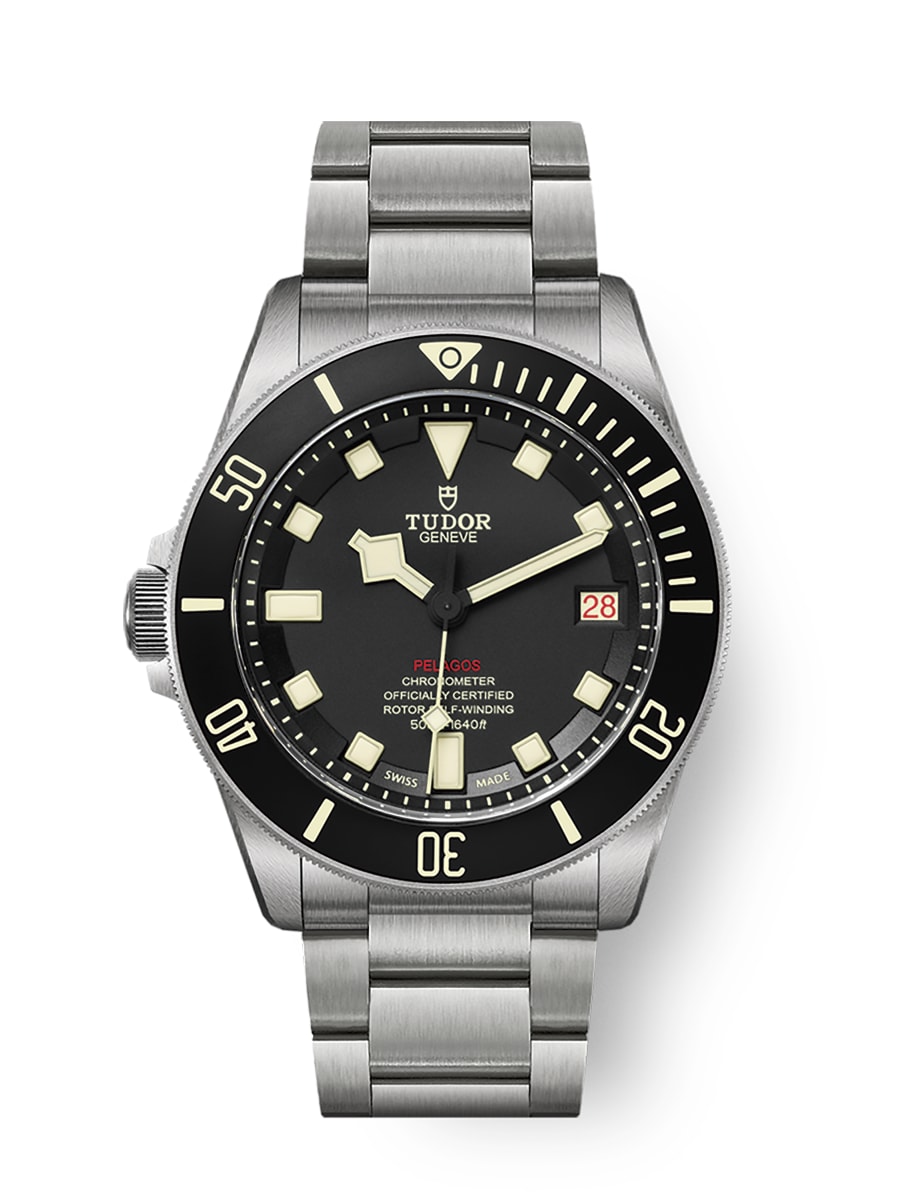
The Pelagos 25500TN launched alongside it: Tudor’s first titanium watch, and the first titanium watch from the Rolex group. The 42mm case was rated to 500m, the ceramic bezel insert was black, and the self-adjusting bracelet clasp maintained tension as a drysuit compressed at depth. At launch, movement was the ETA 2824 (38-hour power reserve); in 2015 Tudor replaced it with the in-house MT5612 (70-hour power reserve, COSC-certified). The current Pelagos LHD retails from $5,625 and trades pre-owned from $3,400 to $4,200 depending on variant.
For buyers: both the 2012 Black Bay and Pelagos are available pre-owned at prices that represent strong value relative to what they deliver. The ETA-movement early Black Bay trades for under $2,800; the ETA Pelagos goes for similar money. If the in-house calibre matters to you, buy the later generation.
Refs 79830RB and 79030N — The In-House Era (2018)
Tudor’s first in-house movement, the MT5621, debuted in the North Flag in 2015. By 2018 two watches crystallised what in-house production meant for buyers: the Black Bay GMT and the Black Bay 58.
The Black Bay GMT, Ref. M79830RB-0001, was Tudor’s first watch with an in-house GMT function. The MT5652 calibre is COSC-certified (−4/+6 seconds per day), beats at 28,800 vph, and delivers 70 hours of power reserve — longer than any Rolex with comparable complications at the price. The 41mm case wears a two-tone burgundy-and-blue “Pepsi” 24-hour bezel in anodized aluminium; a second time zone reads off the GMT hand against the bezel scale. Current retail on the steel rivet bracelet is $5,275; pre-owned examples trade around $3,128 per WatchCharts — roughly 40% below retail, which is an unusually large gap for a watch this well-regarded.
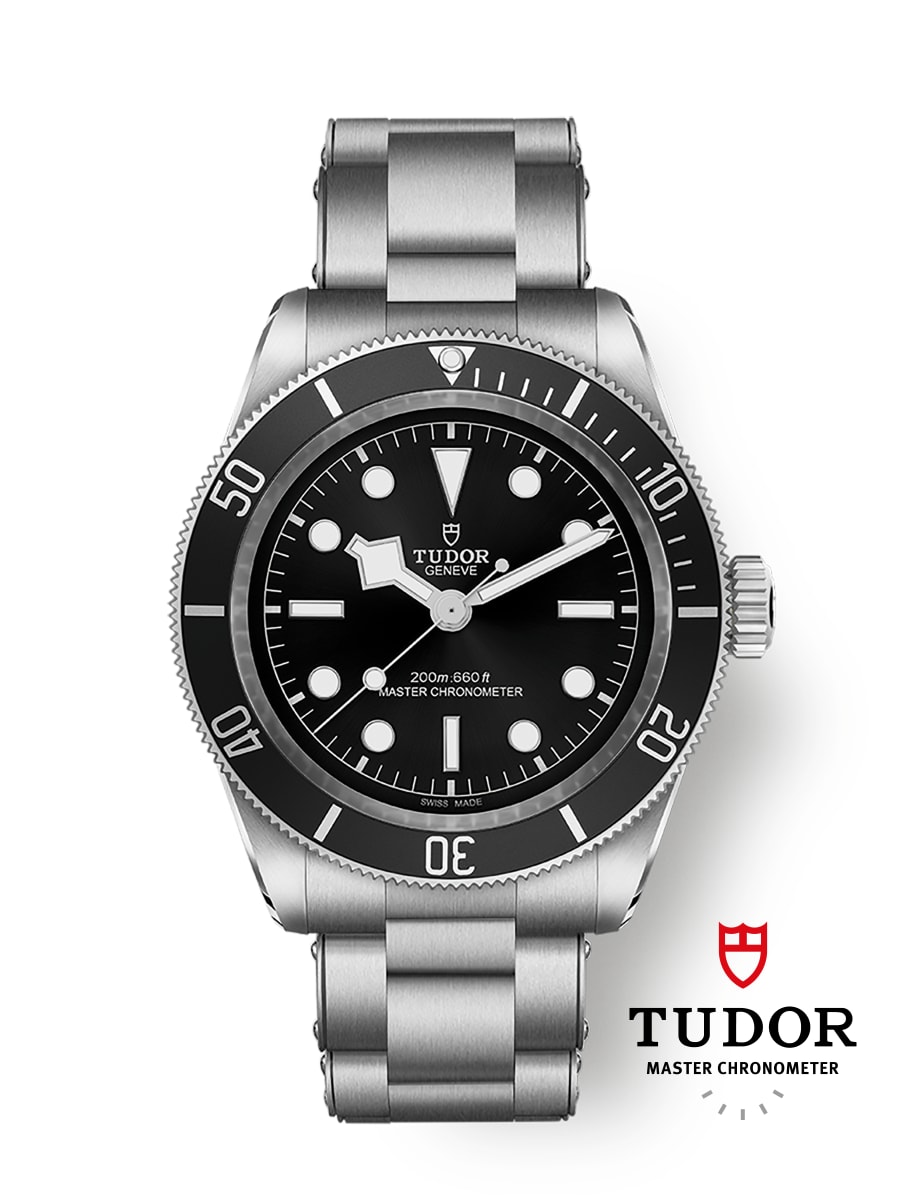
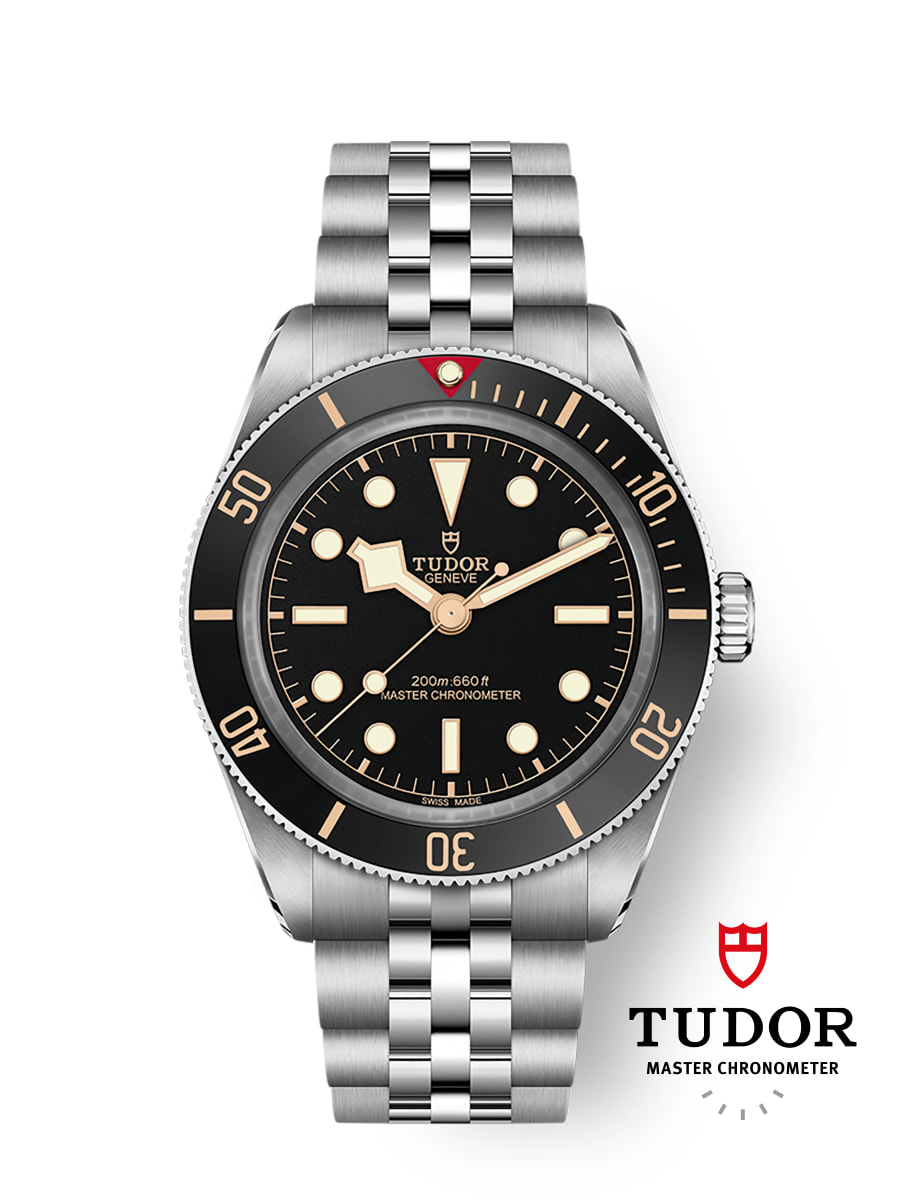
The Black Bay 58, Ref. M79030N-0001, addressed the fit problem: the original Black Bay at 41mm and 15mm thick wore large on many wrists. The 58 is 39mm and 11.9mm thick, proportions referencing the 1958 Big Crown 7924. The current production reference (M7939A1A0NU) runs the MT5400-U, certified by both COSC and METAS (0/+5 seconds per day on the assembled watch, anti-magnetic to 15,000 gauss). Retail is $5,350 on the steel bracelet; the original 79030N generation trades around $3,077, while the newer M7939 trades around $4,197 per WatchCharts as of October 2026.
In 2022 Tudor opened its own 10,642-square-metre manufacture in Le Locle — the first factory the brand has ever fully owned. Movements come from Kenissi, a Le Locle-based manufacturer in which Tudor holds a majority stake and Chanel holds a minority. The facility runs 46 tonnes of automated testing equipment on the Toyota Production System. Both Tudor and Rolex are owned by the Hans Wilsdorf Foundation; otherwise they share nothing: no cases, no movements, no bracelets, no supply chain.
The 10 References at a Glance
| Reference | Year | Movement | Size | Secondary market (Oct 2026) |
|---|---|---|---|---|
| 4463 (First Oyster) | 1947 | Cal. 59, manual | 34mm | $3,000–$8,000 (rare) |
| 7926 Advisor | 1957 | AS 1475, manual alarm | 34mm | $2,000–$6,000 |
| 7924 Big Crown Sub | 1958 | Fleurier 390, auto | 37mm | ~$4,446 (very limited) |
| 7928 Military Sub | 1959 | Fleurier 390, auto | 39mm | $8,000–$16,000 (MN+) |
| 7016/7021 Snowflake | 1969 | ETA 2483/2484, auto | 39mm | $11,000–$16,500 |
| 7169 Monte Carlo | 1971 | Valjoux 7734, manual | ~40mm | $3,000–$8,000 |
| 70330N Heritage Chrono | 2010 | ETA 2892-2054, auto | 42mm | $1,500–$3,000 |
| 79220R Black Bay | 2012 | ETA 2824-2, auto | 41mm | ~$2,753 |
| 25500TN Pelagos | 2012 | ETA 2824 / MT5612* | 42mm Ti | $3,400–$4,200 |
| 79830RB Black Bay GMT | 2018 | MT5652, COSC | 41mm | ~$3,128 |
| M7939A1A0NU Black Bay 58 | 2024 | MT5400-U, COSC+METAS | 39mm | ~$4,197 |
What This History Means if You Are Buying Today
The most important shift in Tudor’s history is that the brand no longer needs to be introduced as “the affordable Rolex.” The Black Bay GMT with an in-house COSC movement, a 70-hour power reserve and a genuine manufacture behind it is a complete watch on its own terms. Its secondary-market discount to retail is larger than Rolex’s — you can buy a pre-owned GMT for around $3,100 versus a $5,275 retail price — but that gap exists because Tudor makes enough of them to supply the market, which is actually a good thing for buyers.
For vintage collectors, the Snowflake 7016/7021 and the military-issued 7928 are the references that have moved most consistently. For buyers who want design history at a modern watch price, the current Black Bay 58 is the most direct heir to the 7924 Big Crown of 1958 — same proportions, same oversized crown logic, same matte black dial, now with an in-house movement. The Tudor vs Rolex value comparison breaks down the numbers across both brands’ current lineups.
The one thing to be clear about: Tudor watches depreciate on the secondary market, as most watches do. They are not investments. They are excellent watches that happen to be available pre-owned at meaningful discounts to new. That is the correct framework for buying one.
The Tudor trademark was first registered in 1926 by Hans Wilsdorf through the Geneva company Veuve de Philippe Hüther. Montres Tudor S.A. was formally incorporated as a separate company on March 6, 1946. The first Tudor Oyster watch, Ref. 4463, appeared in 1947.
Both Tudor and Rolex are owned by the Hans Wilsdorf Foundation, a private Geneva trust. They are sister companies under the same owner rather than one owning the other. Since 2015, when Tudor launched its first in-house movement, the two brands share no cases, movements, bracelets or supply chain.
The Snowflake refers to the square-ended hands and matching square indices introduced on Tudor Submariners Refs 7016 and 7021 in 1969. The design was created for improved underwater legibility. These references are now highly sought-after; Ref. 7016 has a secondary-market value of around $11,000–$16,500 as of October 2026, up roughly 19% in the past twelve months. The same design appears on every current Black Bay.
Yes. The US Navy issued Tudor Submariner Ref. 7928 to its divers from 1964 to 1966, choosing Tudor over the more expensive Rolex Submariner for procurement reasons. The French Marine Nationale also issued Tudor Submariners from the 1960s through the mid-1980s; these are identifiable by the MN stamp on the caseback and trade for $13,000–$16,000 today.
The current Black Bay 58 (reference M7939A1A0NU) runs the in-house MT5400-U calibre, certified by both COSC (−4/+6 s/day) and METAS Master Chronometer (0/+5 s/day on the assembled watch, anti-magnetic to 15,000 gauss). The movement has a 65-hour power reserve, silicon balance spring, and variable inertia balance wheel. Case is 39mm steel, 11.9mm thick, with 200m water resistance.
The Black Bay GMT and Black Bay 58 are well-made watches with in-house COSC-certified movements at retail prices of $5,275 and $5,350. Pre-owned first-generation models trade for $3,100–$3,200, which represents a substantial discount to retail for a watch that holds up well to daily wear. Tudor watches do depreciate — they are not investments — but the pre-owned gap makes entry straightforward for buyers who do not need a new warranty.
The military-issued Ref. 7928 with MN (Marine Nationale) casebacks commands the highest prices among all Tudor Submariners, trading for $13,000–$16,000 as of October 2026. The Snowflake Ref. 7016 follows closely at $11,000–$16,500. The Big Crown 7924 is rare with limited market data; civilian 7928 examples run $8,000–$15,000. All require specialist assessment before purchase.
Final Verdict
Tudor’s history is a story of two distinct acts. The first is the era of borrowed cases, military contracts and Snowflake dials — watches that gained credibility in extreme environments rather than from marketing. The second is the post-2012 manufacture era, where Tudor earns its price on the strength of its own engineering. The brand is no longer selling proximity to Rolex; it is selling a complete 39mm or 41mm dive watch with an in-house movement, a factory in Le Locle and a heritage worth knowing.
Buy the current Black Bay 58 or GMT if you want a new watch you can wear hard and not worry about. Buy the vintage Snowflake 7016 or military 7928 if you want something that carries documented history on the dial. The pre-owned ETA-movement Black Bay 79220R is the best entry point if budget is the constraint — around $2,750 for a watch with genuine design pedigree. The Rolex Submariner vs Tudor Black Bay comparison will help you decide whether the Rolex premium is justified for your situation.
Related Articles
- Tudor Black Bay Buying Guide (2026): Every Reference, Movement and Price Explained
- Tudor Pelagos Buying Guide (2026): Every Reference, Movement and Price Explained
- Tudor Black Bay Chrono Buying Guide (2026): Every Reference, Movement and Price Explained
- Tudor Northflag GMT Review (2026): METAS-Certified Tool GMT Revives a Legend
Sources: Tudor official history; WatchCharts Tudor secondary market data (October 2026); Loupe Watch Tudor Submariner price guide; SJX Watches, Tudor Kenissi Le Locle factory visit (2023)


