
⏱ TL;DR
Grand Seiko wins on movement innovation, dial artistry, and horological value — the Spring Drive is technically unmatched at $6,900. Cartier wins on brand recognition, jewellery-house prestige, and pre-owned resale strength. If you want a watch that rewards a lifetime of closer inspection, choose Grand Seiko. If you want immediate social recognition on the wrist, choose Cartier.
At first glance, Grand Seiko and Cartier seem like an unlikely pairing. One is a Japanese manufacture celebrated for nature-textured dials and the technically extraordinary Spring Drive movement; the other is a 179-year-old French maison better known for diamond jewellery than escapement innovation. Yet both brands regularly appear on the same shortlist for buyers seeking a sophisticated dress or everyday-luxury watch in the $5,000–$12,000 range — and the choice between them reveals a great deal about what you actually value in a timepiece. This guide compares Grand Seiko and Cartier across movement technology, design philosophy, price, and long-term value to help you make the right decision for your wrist and your lifestyle.
Brand Heritage & Origins
Grand Seiko was born in 1960 when Seiko’s Suwa Seikosha workshop set out to create the finest watch Japan could produce. While the parent company pursued affordability and volume, the Grand Seiko team pursued something entirely different: obsessive accuracy, hand-finishing that rivals Geneva’s finest ateliers, and dials inspired by Japan’s natural landscapes — forests blanketed in snow, birch groves, misty mountain lakes, and the play of light across a still-water surface. Grand Seiko spun off as an independent brand in 2017, with dedicated workshops at the Shinshu Watch Studio in Nagano and the Shojiro Ishibashi Shizukuishi Watch Studio in Iwate Prefecture. Both facilities combine centuries-old Japanese craft with precision engineering to a degree rarely seen outside Switzerland’s top five houses.
Cartier’s story begins in Paris in 1847, when Louis-François Cartier founded the maison on the Rue Montorgueil. The house rose to international prominence under Alfred, Louis, and Pierre Cartier in the early 20th century, inventing two of watchmaking’s most recognisable case shapes: the Santos (1904, commissioned for aviator Alberto Santos-Dumont — widely regarded as the first purpose-built wristwatch) and the Tank (1917, inspired by the aerial silhouette of a Renault FT tank). Today, Cartier sits within the Richemont Group alongside IWC, Jaeger-LeCoultre, and Vacheron Constantin, with movements produced in La Chaux-de-Fonds. Cartier’s identity is inseparable from French luxury culture — its watches are as much jewellery as horology, and that is precisely the point.
Design Philosophy
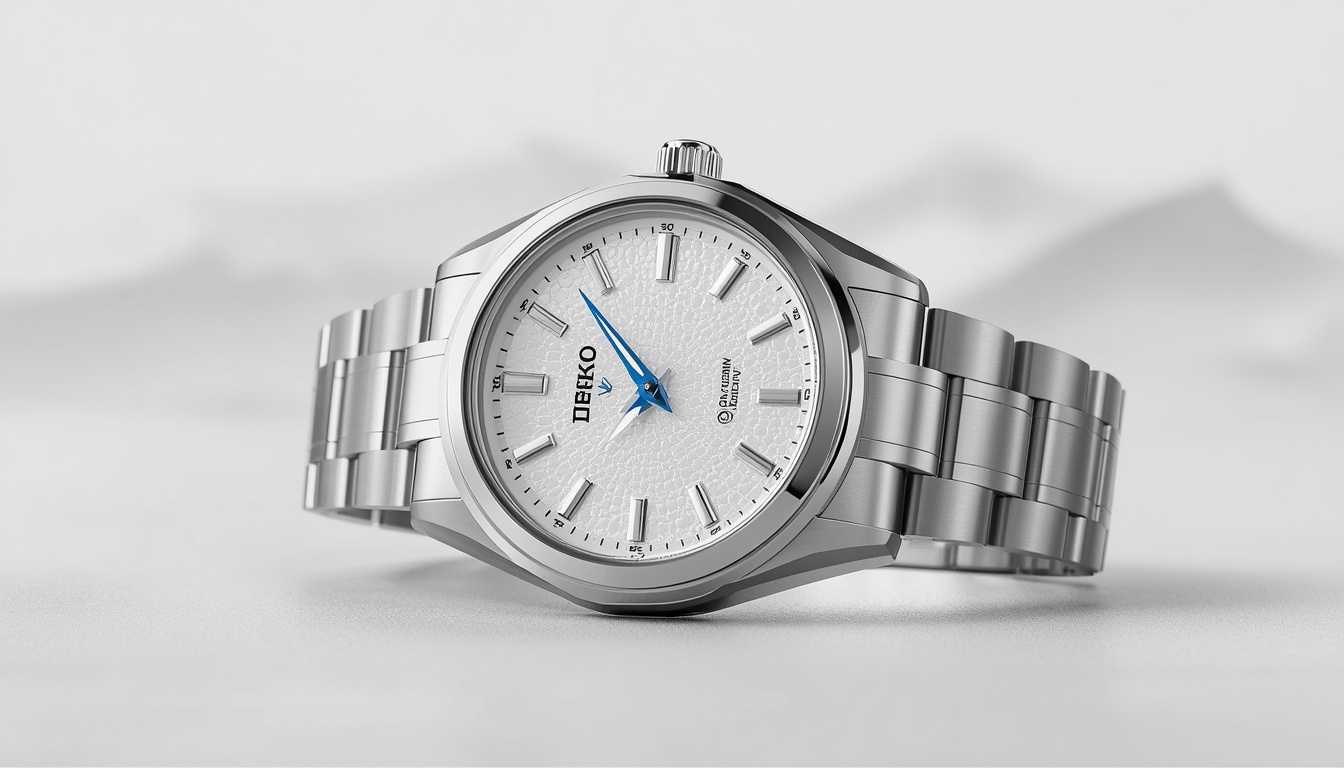
Grand Seiko’s aesthetic is defined by the Seiko Design Code first articulated in the 1960s: sharp, flat surfaces separated by crisp bevels, ultra-fine Zaratsu polish (a hand-polishing technique borrowed from Japanese sword-making that produces a distortion-free mirror finish), and applied indices that catch and reflect light with jewel-like precision. The brand’s most celebrated dials — the Snowflake (SBGA211), the Skyflake (SBGA407), the Midnight Blue (SBGA439) — are hand-textured by artisans using techniques developed over decades, each dial a miniature landscape. A Grand Seiko tells a story well before you check the time; the watch rewards sustained attention in a way few Swiss pieces at any price point can match.
Cartier takes the opposite approach: geometry and brand identity first, story second. The Santos’s square case, exposed screws, and integrated bracelet create instant brand recognition from twenty feet away. The Ballon Bleu’s round case appears to float above the hidden lugs, with its iconic cabochon sapphire crown nestled in the case flank. Both are conversation starters in ways that a Grand Seiko often is not — most people at a dinner table will identify a Cartier within seconds, while the Grand Seiko’s depth and identity reveal themselves only to those who know to look. Neither approach is superior; they serve fundamentally different psychological needs on the wrist.
Specs Head-to-Head
| Specification | Grand Seiko SBGA211 Snowflake | Cartier Ballon Bleu 36mm (Auto) |
|---|---|---|
| Case diameter | 41mm | 36mm |
| Case material | High-intensity titanium | Stainless steel |
| Movement | Cal.9R65 Spring Drive | Cal.076 automatic |
| Power reserve | 72 hours | 42 hours |
| Water resistance | 100m | 30m |
| Accuracy | ±1 sec/day | ±-4/+6 sec/day (typical) |
| Crystal | Sapphire (double anti-reflective) | Sapphire |
| Lug width | 20mm | 16mm |
| Price (USD, 2026) | ~$6,900 | ~$7,800 |
All prices approximate at retail as of mid-2026. Verify current pricing at grand-seiko.com and cartier.com.
Movement & Technology
Grand Seiko’s Spring Drive, powering the SBGA211 and dozens of other references, is a genuine horological landmark. Introduced in 1999 after 28 years of development, the Spring Drive uses a traditional mainspring to power the watch but replaces the conventional lever escapement with a tri-synchro regulator — a glide wheel whose rotation rate is governed by electromagnetic braking rather than the mechanical impulse-and-lock system used in virtually every other mechanical watch in existence. The result is accuracy of ±1 second per day (exceeding COSC chronometer standards, which permit ±-4/+6 sec/day), a seconds hand that glides continuously with no tick, and a movement that is simultaneously mechanical, electronic, and uniquely Japanese. The titanium SBGA211 case saves approximately 30% in weight compared to steel equivalents, reducing wrist fatigue over long wear.
Cartier’s manufacture calibres are competently executed Swiss lever-escapement movements with in-house finishing. The Cal.076 (Ballon Bleu automatic) and Cal.1904-PS MC (Santos automatic) are reliable, beautifully decorated with Côtes de Genève stripes and bevelled bridges, and offer the 42–48 hour power reserves typical of the genre. The Cal.1847 MC, used in Cartier’s quartz references, is accurate to ±0.07 sec/day by design but lacks the mechanical soul of the Spring Drive. To be clear: Cartier’s movements are thoroughly adequate, and for a watch purchased primarily for its design and brand identity, that is entirely sufficient. But if technical innovation motivates your purchase, Grand Seiko’s engineering lead is undeniable. For those interested in exploring GS movement technology further, the Grand Seiko Hi-Beat vs Spring Drive guide covers both in depth.

Price & Value
Grand Seiko and Cartier overlap at several price tiers, allowing a direct value comparison at each level:
| Model | Price (USD, 2026) | Key Strength |
|---|---|---|
| Cartier Tank Must (quartz) | ~$3,150 | Iconic entry-level Cartier; great starting piece |
| Grand Seiko SBGX353 (quartz) | ~$4,100 | Elegance Collection entry; Zaratsu dial |
| Grand Seiko SBGA211 Snowflake | ~$6,900 | Spring Drive, titanium, nature-textured dial |
| Cartier Ballon Bleu 36mm (auto) | ~$7,800 | Steel automatic; Cartier’s most popular watch |
| Cartier Santos Medium (auto) | ~$9,800 | Sportier Santos silhouette; integrated bracelet |
| Grand Seiko Tentagraph SLGC006 | ~$14,500 | Hi-Beat chronograph; GS pinnacle |
On pure horological value, Grand Seiko delivers more per dollar at each tier. The SBGA211 ($6,900) outperforms the Ballon Bleu 36mm (~$7,800) on movement accuracy, water resistance, and finishing complexity. The pre-owned market tells a different story: Cartier pieces — especially the Santos and Ballon Bleu — enjoy stronger brand recognition internationally and typically sell faster and at firmer relative prices than Grand Seiko on platforms like Chrono24 and WatchBox. This reflects brand awareness rather than watchmaking quality, but it is a real consideration if you ever plan to sell. For those weighing a high-end automatic option, a quality single watch winder is a wise accessory investment for either brand’s automatic references.
Grand Seiko & Cartier vs The Competition
Both brands face strong competition at the $6,000–$10,000 price point. Here’s how the field compares:
| Watch | Price (USD) | Movement | Key Appeal |
|---|---|---|---|
| Grand Seiko SBGA211 Snowflake | ~$6,900 | Cal.9R65 Spring Drive, 72h | ±1 sec/day accuracy; nature dial art |
| Cartier Ballon Bleu 36mm Auto | ~$7,800 | Cal.076, 42h | French prestige; instant recognition |
| IWC Portugieser Auto 40 | ~$8,700 | Cal.82100, 60h | Technical Swiss tradition; clean dial |
| Omega Aqua Terra 150M 38mm | ~$6,400 | Cal.8900 METAS, 60h | METAS certified; 15,000-gauss resistance |
| Rolex Datejust 41 | ~$10,300 | Cal.3235, 70h | Rolex prestige; best resale value |
| Jaeger-LeCoultre Master Control | ~$8,200 | Cal.899/1, 38h | Swiss heritage; Manufacture depth |
For a direct Swiss comparison to Grand Seiko’s ethos, the Grand Seiko vs IWC guide and the Grand Seiko vs JLC breakdown cover the most relevant alternatives in depth. If you are weighing a different Cartier silhouette, the Cartier Ballon Bleu review and Cartier Tank Must review are the best starting points. A premium watch travel roll is ideal for either brand when travelling.
Who Should Buy Which
Buy Grand Seiko if you: Prioritise movement technology and accuracy above all. Love nature-inspired dial art and want to own something that rewards daily contemplation. Are shopping in the $5,000–$10,000 range for maximum horological value per dollar. Don’t mind that most people at a dinner table won’t immediately recognise the brand. Want a lighter titanium case that wears comfortably for 12+ hours. Are drawn to the Grand Seiko ecosystem of collections and seasonal dial releases.
Buy Cartier if you: Value instant brand recognition and fashion-forward design as core criteria. Want a watch that doubles as a statement piece in social settings — business meetings, formal dinners, galleries. Have a pre-owned resale consideration in mind; Cartier’s international name recognition supports its secondary market. Prefer the Santos or Ballon Bleu silhouette’s distinctive French jewellery-house aesthetic. Will wear the watch primarily in formal or smart-casual contexts where Cartier’s visual identity carries weight. Consider the aftermarket leather strap options for the Ballon Bleu 36mm, which accept standard 16–18mm lugs.
Verdict
Grand Seiko vs Cartier is ultimately the contest between a watchmaker’s watch and a maison’s watch — and neither answer is wrong. Grand Seiko offers a technically stronger case in every measurable horological category; Cartier offers stronger social currency and broader international recognition. Our recommendation: if you are buying purely for yourself and care deeply about what is inside the case — and on the dial — buy the Grand Seiko SBGA211 Snowflake. You will never tire of it. If you wear your watch as much for others as for yourself, and want a piece that speaks immediately to those around you, the Cartier Ballon Bleu 36mm will never disappoint. For more context on Grand Seiko’s full range, the Grand Seiko vs Omega guide and Grand Seiko vs Rolex breakdown are essential reading before deciding.
Frequently Asked Questions
It depends on what you mean by “better.” Technically and mechanically, Grand Seiko leads: the Spring Drive calibre is more accurate, the Zaratsu polishing more labour-intensive, and the titanium construction more innovative. In terms of brand recognition and social prestige, Cartier leads in most international markets. Grand Seiko is the watchmaker’s choice; Cartier is the luxury lifestyle choice.
Grand Seiko’s Spring Drive movement uses a tri-synchro regulator — a glide wheel braked electromagnetically — instead of the traditional mechanical lever escapement found in virtually all Swiss automatic movements including Cartier’s. This allows the Spring Drive to achieve ±1 second per day accuracy compared to the ±-4/+6 sec/day typical of standard lever-escapement automatics. It is one of the most significant horological innovations of the past century.
Generally yes, in most international pre-owned markets. Cartier — particularly the Santos and Ballon Bleu — benefits from extremely wide brand recognition globally, which supports pre-owned demand. Grand Seiko is appreciated more in Japan, Hong Kong, and among dedicated horological enthusiasts. In the $6,000–$10,000 range, Rolex and Cartier hold resale value most consistently of any mainstream brands. Grand Seiko’s secondary market has grown steadily but remains thinner.
The closest Grand Seiko equivalent to the Cartier Santos Medium — a sporty-dress steel automatic with a strong design identity — is probably the Grand Seiko SBGM221 Elegance GMT or the SBGA293 Elegance Spring Drive. Both offer a dressed-up aesthetic with significant movement prestige. For the Santos’s iconic silhouette impact, Grand Seiko has no direct match — its design language is more subtle and introspective by nature.
Yes, increasingly so — but not yet to the same degree as Cartier, Rolex, or Omega. In specialist watch communities, Grand Seiko commands enormous respect. In casual social settings, the brand is still relatively unfamiliar to non-enthusiasts in Western markets. This is changing as Grand Seiko expands its boutique presence globally, but Cartier’s instant brand recognition remains a clear practical advantage for buyers who care about social signalling.
For a pure dress watch under $10,000, Grand Seiko’s Elegance Collection — especially the SBGA211 Snowflake ($6,900) or SBGW301 hand-wound ($5,000) — offers the most refined dial artistry and movement quality available at these price points. Cartier’s Ballon Bleu and Santos are equally dress-appropriate but prioritise silhouette and brand identity over technical depth. Both are excellent choices; the deciding factor is typically whether you prefer Japanese craftsmanship or French heritage.
The Grand Seiko SBGA211 Snowflake is rated to 100m water resistance — suitable for swimming and snorkelling but not scuba diving. Most Cartier watches, including the Ballon Bleu, are rated to 30m, making them splash-resistant only (no swimming). For serious water activities, neither is the right tool; consider the Grand Seiko Sport Collection or a dedicated dive watch instead. Both the Snowflake and Ballon Bleu are best treated as dressed-up everyday watches rather than sport pieces.
Recent Articles
- Omega Speedmaster Professional Moonwatch Buying Guide (2026)
- Seiko vs Rolex (2026): Japanese Precision or Swiss Prestige
- Tudor Black Bay GMT Review (2026)
- Omega Seamaster Planet Ocean Buying Guide (2026)
- Rolex vs Grand Seiko (2026): Swiss Prestige or Japanese Perfection
This article was researched with the help of AI. While we strive to keep all information accurate and up to date, there may be errors. If you notice any discrepancies, please contact us.
Leave a Reply
You must be logged in to post a comment.