
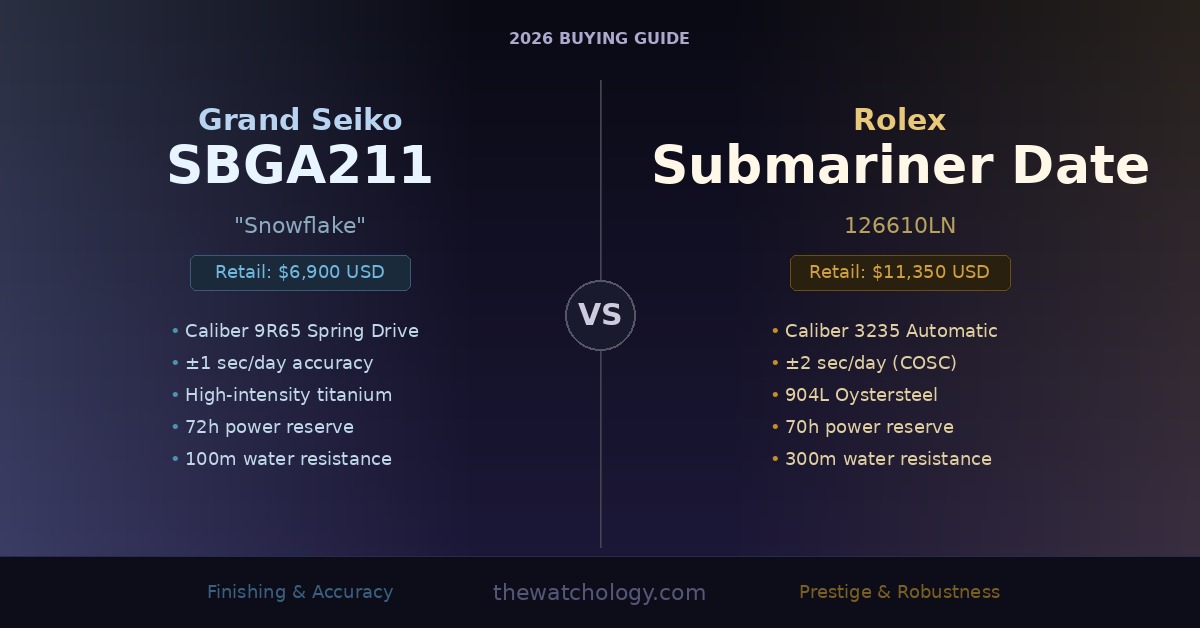
Grand Seiko Snowflake SBGA211 vs Rolex Submariner 126610LN: The 2026 Buying Guide
Two watches. Two philosophies. One decision. The Grand Seiko SBGA211 “Snowflake” and the Rolex Submariner Date 126610LN occupy very different corners of the luxury watch world — yet they sit in the same conversation for the serious buyer spending around $7,000–$12,000 on a watch that will define their collection. This guide breaks down every meaningful difference: movement technology, finishing, value retention, wearability, and which one actually makes sense for your wrist and your life in 2026.
Quick Specs Comparison
| Specification | Grand Seiko SBGA211 “Snowflake” | Rolex Submariner Date 126610LN |
|---|---|---|
| Case Diameter | 41mm | 41mm |
| Case Material | High-intensity titanium (Titan) | Oystersteel (904L stainless steel) |
| Movement | Caliber 9R65 Spring Drive | Caliber 3235 automatic |
| Power Reserve | 72 hours | 70 hours |
| Accuracy | ±1 sec/day (±15 sec/month) | ±2 sec/day (chronometer certified) |
| Water Resistance | 100m (10 bar) | 300m (30 bar) |
| Lug Width | 20mm | 20mm |
| Retail Price (US, 2026) | $6,900 | $11,350 |
| Secondary Market | ~$4,500–$5,500 | ~$13,000–$16,500 |
| Warranty | 3 years | 5 years |
The Movements: Spring Drive vs COSC Automatic
This is where the two watches diverge most dramatically — and where Grand Seiko makes its strongest argument.
The SBGA211 runs on the Caliber 9R65, Grand Seiko’s Spring Drive movement. Spring Drive is a genuine technological achievement: a mainspring-powered movement that uses a glide wheel and electromagnetic brake regulated by a quartz oscillator — no battery required. The result is accuracy of ±1 second per day, roughly twice as accurate as the Submariner’s COSC-certified ±2 seconds per day. The seconds hand glides in a perfectly smooth, continuous motion — a visual experience unlike any ticking or even most sweeping mechanical watches.
The Rolex Caliber 3235 is, by any conventional standard, an exceptional movement. It features a Chronergy escapement for 15% greater energy efficiency, a Parachrom hairspring for shock and magnetic resistance, and a 70-hour power reserve. It is robustly tested, impeccably reliable, and widely regarded as one of the best automatic movements in production. COSC certification confirms ±4 to +6 seconds per day; Rolex’s own internal standard is tighter at ±2 seconds per day.
For sheer accuracy, Spring Drive wins. For robustness in harsh conditions — saltwater, shocks, magnetic fields — the 3235 is extraordinarily well proven. Neither will ever let you down in daily wear.
Dial and Finishing: Where Grand Seiko Shines
The SBGA211’s dial is one of the most celebrated in watchmaking — and justifiably so. The “Snowflake” texture is created by a special silver-plating process that replicates the natural crystalline structure of snow. Up close, under changing light, the dial shifts from flat white to a shimmering, three-dimensional field of delicate ice crystals. The name is no marketing hyperbole: it genuinely looks like the surface of packed snow photographed at macro scale.
Grand Seiko’s Zaratsu polishing technique — originally developed for Japanese sword-making — produces distortion-free mirror surfaces on the case flanks and case back. The contrast between the polished and brushed surfaces on the SBGA211’s titanium case is startling in its precision. No other watchmaker at this price point achieves comparable finishing quality.
The Rolex Submariner’s dial is flawless in a different way — purposeful, legible, and unmistakably tool-watch. The black Cerachrom ceramic bezel on the 126610LN is virtually scratchproof and UV-resistant; the colour will not fade over decades. Rolex’s applied indices and Mercedes hands are finished to a very high standard. But they are mass-produced to a quality standard, not handcrafted to an artistic one. The Submariner’s design is iconic precisely because it is functional — a dive instrument first, a status symbol second.
Case Material: Titanium vs Oystersteel
Grand Seiko uses high-intensity titanium for the SBGA211’s case and bracelet — a proprietary alloy that is approximately 30% lighter than stainless steel and significantly more scratch-resistant than standard titanium. For wrists that fatigue under heavy metal, the Snowflake’s lightweight wear is genuinely revelatory. A full day’s wear feels almost like no watch at all.
Rolex’s 904L Oystersteel is a corrosion-resistant austenitic steel alloy used primarily in aerospace and chemical industries. It accepts Rolex’s high-polish finishing better than most steels and offers excellent corrosion resistance. It is heavier than titanium, which some buyers actually prefer — a sense of solid, weighty presence on the wrist. The Submariner wears its heft as a feature, not a bug.
Water Resistance: An Honest Assessment
The Submariner’s 300-metre water resistance is not a trivial number. It reflects a comprehensively waterproof Oyster case with a screw-down Triplock crown that can genuinely be worn diving, snorkelling, or surfing without a second thought. The Submariner was designed to go underwater and has been tested in service for 70 years.
The SBGA211’s 100-metre rating is fine for swimming and splash resistance, but it is not a diver’s watch by COSC/ISO 6425 standards. The crown on a Spring Drive movement requires a slightly more complex seal. If you plan to dive, the Submariner is the correct choice. If you plan to admire art and attend meetings, 100m is more than adequate for any reasonable activity.
Wearability and Comfort
Both watches measure 41mm across — but they feel different on the wrist in every other dimension.
The SBGA211 wears large. Its case height and lug-to-lug measurement are generous. Combined with the titanium bracelet, it sits comfortably but visibly on most wrists — it makes a statement without being aggressive. The titanium bracelet’s lightness contributes to the impression that you’re wearing something precious and considered.
The Submariner wears smaller than its 41mm suggests, thanks to Rolex’s short lug-to-lug distance and tapered bracelet design. The Oysterlock clasp with Glidelock extension allows 20mm of micro-adjustment in 2mm increments — a practical feature for temperature changes and shirt sleeve clearance. The Submariner sits naturally under a cuff and disappears on the wrist in the best possible sense.
Price and Value Retention
This is the starkest difference between the two watches — and it cuts in opposite directions depending on what you’re optimising for.
The SBGA211 retails at $6,900 USD from authorised Grand Seiko retailers in 2026. On the secondary market, it trades at approximately $4,500–$5,500 — a significant discount of 20–35% below retail. This means you can buy a pre-owned example in excellent condition for substantially less than new. It also means Grand Seiko is not (yet) a strong financial investment in the traditional watch-collector sense.
The Rolex Submariner Date 126610LN retails at $11,350 USD from authorised Rolex dealers — assuming you can find one willing to sell it to you without a long waitlist or relationship history. On the secondary market, unworn examples trade between $13,000 and $16,500. That premium above retail has persisted for years and shows no sign of collapsing. For buyers who view watches partly as assets, the Submariner has a decades-long track record of value retention that no other brand reliably matches.
Put simply: the SBGA211 is a better watch for the money if you plan to wear it; the Submariner is the better watch to hold if you plan to sell it.
Brand Prestige and Recognition
Rolex is the most recognised luxury watch brand on earth. A Submariner communicates success, taste, and wealth across virtually every culture and context. Non-watch enthusiasts will recognise it instantly. This is not a trivial consideration if you wear your watch in business or social settings where these signals matter.
Grand Seiko is recognised by watch enthusiasts as one of the finest manufacturers in the world — perhaps the finest at certain aspects of finishing and accuracy. But it remains a connoisseur’s choice. Wearing a Snowflake SBGA211 will elicit blank looks from most civilians and reverent nods from people who genuinely know watches. Depending on your perspective, that’s either a drawback or precisely the appeal.
Who Should Buy the Grand Seiko SBGA211?
Buy the Snowflake if you:
- Prioritise dial artistry and movement accuracy above brand recognition
- Prefer a lighter watch on the wrist
- Want something that will spark conversations with people who actually know watches
- Are buying at a secondary market price of $4,500–$5,500, where the value proposition is exceptional
- Already own a Rolex or other iconic brand and want something technically remarkable
Who Should Buy the Rolex Submariner 126610LN?
Buy the Submariner if you:
- Want universal recognition and a watch that works in every social and professional context
- Need genuine water resistance for diving or water sports
- Care about long-term value retention and resale liquidity
- Prefer a sporty, tool-watch aesthetic that works under a suit or with a wetsuit
- Are buying your first serious luxury watch and want the definitive statement piece
Our Verdict
For pure watchmaking artistry, the SBGA211 wins at every level — movement technology, dial finishing, case quality per dollar. It is one of the most beautiful objects you can put on your wrist for under $7,000 new, or under $5,500 pre-owned.
The Submariner wins on everything else: recognition, robustness, water resistance, and the immovable fact of Rolex’s resale market. It is arguably the single most pragmatic luxury watch you can own.
If you’re debating between them and money is not a constraint, buy the one that resonates with you aesthetically — you’ll be right either way. If budget matters, buy the Snowflake pre-owned and spend the savings on a strap. You will own something that most watch journalists consider one of the genuinely great watches of the past twenty years, for less than you’d pay retail for its Japanese competitors. That’s a remarkable position to be in.
For more watch comparisons and buying guides, explore our Rolex reviews and our deep-dive into the Rolex Submariner history. We also have a full breakdown of the Omega Speedmaster for those considering adding a chronograph alongside a sports watch.
Frequently Asked Questions
Is the Grand Seiko SBGA211 worth buying in 2026?
Yes — particularly at secondary market prices of $4,500–$5,500. The SBGA211 offers Spring Drive movement technology (±1 sec/day accuracy), exceptional Zaratsu-polished finishing, and one of the most artistically distinctive dials in watchmaking. For the price of a mid-spec Swiss automatic, you get engineering and craft that exceeds far more expensive competitors.
What is the current retail price of the Rolex Submariner 126610LN in 2026?
The 2026 US retail price for the Rolex Submariner Date 126610LN (black bezel, black dial, Oystersteel) is $11,350 from authorised Rolex dealers. Secondary market prices for unworn examples currently range from approximately $13,000 to $16,500, reflecting the persistent premium above retail driven by demand and waitlists.
What movement does the Grand Seiko SBGA211 use?
The SBGA211 uses the Grand Seiko Caliber 9R65, a Spring Drive movement. Spring Drive combines a traditional mechanical mainspring with a quartz-regulated glide wheel, producing a smooth-sweeping seconds hand and accuracy of ±1 second per day — approximately twice as accurate as COSC-certified mechanical movements. The power reserve is 72 hours.
Can you swim with the Grand Seiko SBGA211?
Yes. The SBGA211 is water-resistant to 100 metres (10 bar), which is sufficient for swimming, snorkelling, and everyday water exposure. However, it is not rated for scuba diving (which requires ISO 6425 certification and a minimum of 100m with safety margin). For diving, the Rolex Submariner’s 300m rating is more appropriate.
Does Grand Seiko hold its value like Rolex?
No — at least not currently. Grand Seiko watches typically depreciate 20–35% from retail on the secondary market, similar to most Swiss luxury brands (excluding Rolex, Patek Philippe, and a handful of Audemars Piguet references). Grand Seiko’s brand recognition is growing globally, but its secondary market does not yet exhibit the demand-driven premiums seen with Rolex. Buyers who prioritise value retention should favour the Submariner.
How long is the warranty on the Grand Seiko SBGA211?
Grand Seiko provides a 3-year international warranty on the SBGA211 covering manufacturing defects. Rolex offers a 5-year international warranty on the Submariner. Both warranties require the watch to be serviced by authorised brand-affiliated watchmakers to remain valid.
Which is better for everyday wear — the SBGA211 or the Submariner?
Both are excellent daily wearers, but they suit different lifestyles. The SBGA211’s titanium case and bracelet make it noticeably lighter and more comfortable for all-day wear in office or social environments. The Submariner is more robust — scratch-resistant Cerachrom bezel, 300m water resistance, and a proven Oyster case — making it the superior choice for active or outdoor lifestyles. For office and travel wear, the Snowflake; for sport and adventure wear, the Submariner.
What does “Snowflake” refer to on the Grand Seiko SBGA211?
The “Snowflake” nickname refers to the SBGA211’s distinctive white dial, which is textured via a special silver-plating process to replicate the crystalline surface of wind-sculpted snow. The texture was inspired by the snowfields of the Shinshu region of Japan — the location of Grand Seiko’s Shinshu Watch Studio — and changes dramatically in appearance depending on the angle of light. It is one of the most visually distinctive dials in luxury watchmaking.
Leave a Reply