
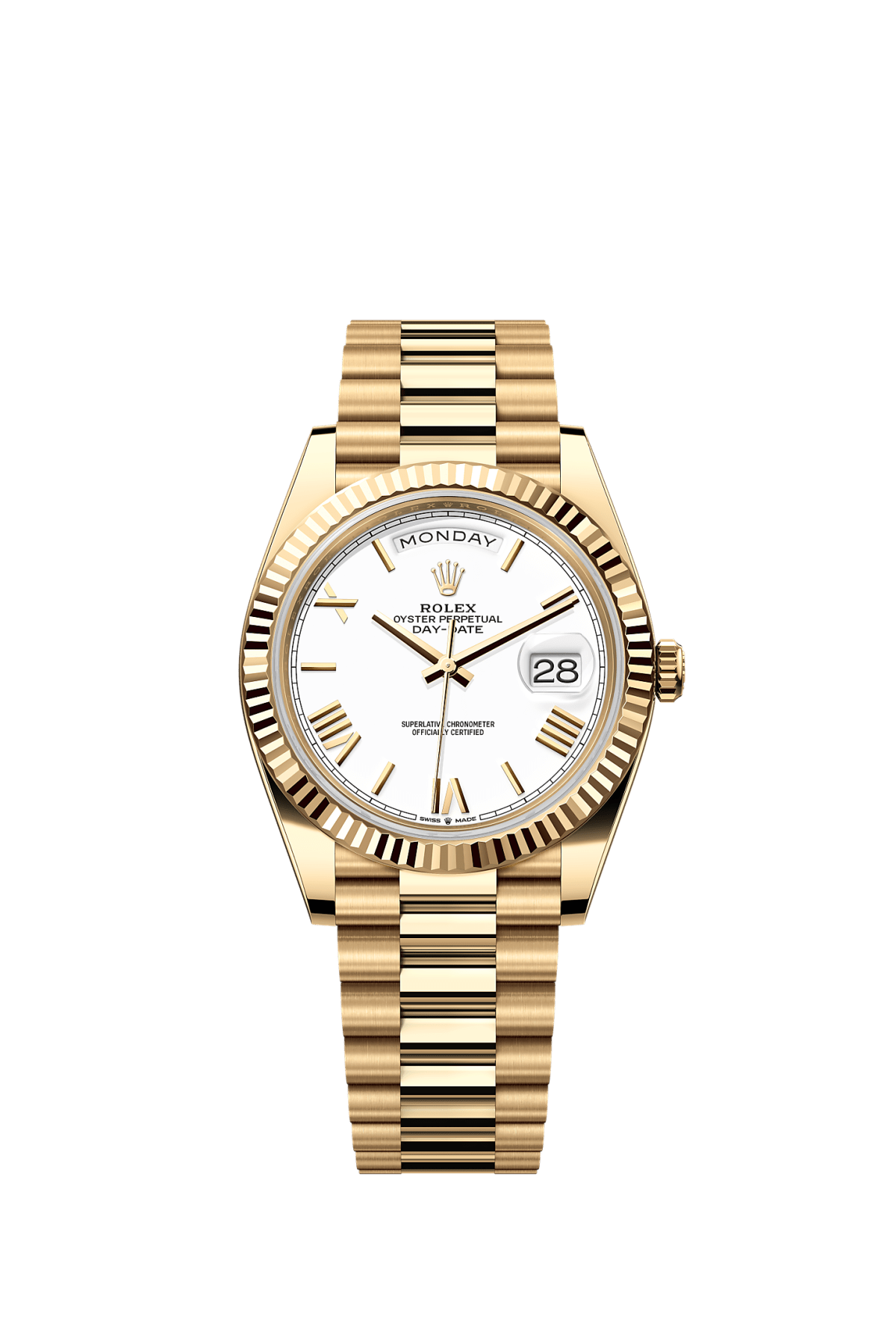
The Rolex Day-Date is the only watch in the Rolex catalogue made exclusively in precious metals — and in 2026, it remains the ultimate statement of arrival, worn by world leaders and serious collectors alike. The current collection spans two case sizes (36 mm and 40 mm), four metals (yellow gold, white gold, Everose gold, and platinum), and a staggering range of dials from classic champagne lacquer to meteorite stone. This guide covers every current reference, the Calibre 3255 movement, 2026 retail prices, and exactly which Day-Date is right for you.
Prices and specifications as at July 2026. Always verify with authorised dealers.
- The President’s Watch: Why the Day-Date Is Different
- Day-Date 36 vs Day-Date 40: Which to Choose?
- Day-Date 40 References (2026)
- Day-Date 36 References (2026)
- Movement: Calibre 3255
- Dials: The Day-Date’s Secret Weapon
- 2026 Price Guide
- Buying the Day-Date: What to Know
- Final Verdict
- Frequently Asked Questions

The President’s Watch: Why the Day-Date Is Different
The Day-Date debuted in 1956 as a horological milestone: the world’s first wristwatch to display both the day of the week spelled out in full and the date simultaneously. Rolex paired the achievement with an equally significant decision — the Day-Date would be made exclusively in 18k gold or platinum. No steel. No two-tone. That has never changed in 70 years of production.
From the start, Rolex positioned it at the apex of their catalogue and reserved their finest new bracelet — the three-link Presidentiale, now universally known as the President bracelet — for this watch alone. The name “President” attached itself because Dwight D. Eisenhower wore one in 1956, and subsequent American presidents including Lyndon Johnson and Richard Nixon were photographed in theirs. The watch became a shorthand for a certain kind of achievement, and it has never lost that connotation.
Today the Day-Date sits above everything else Rolex makes. You can buy a Submariner or Explorer in steel at your local authorised dealer with a reasonable wait. The Day-Date is categorically different — a watch in precious metal, priced accordingly, aimed at a buyer who wants Rolex at its most explicit. For a broader look at the brand’s lineup, see our Top 10 Best-Selling Rolex Watches 2026 guide.
Day-Date 36 vs Day-Date 40: Which Should You Choose?
The current Day-Date range is divided into two case sizes. The Day-Date 36 (references M128xxx) uses a 36 mm case — the original size that the Day-Date wore for the first 59 years of its existence. The Day-Date 40 (references M228xxx) uses a 40 mm case introduced in 2015 to replace the short-lived Day-Date II (41 mm). Both sizes use the Calibre 3255, offer the same bezel options and bracelet choices, and share 100 m water resistance.
The decision is purely proportional. For wrists 7 inches (18 cm) and above, the 40 mm reads in balance; for 6.5 inches (16.5 cm) and below, the 36 mm tends to sit more elegantly and carry more of the watch’s historical authority. Try both on before deciding — the difference is more obvious on the wrist than it appears in photographs.
| Specification | Day-Date 36 | Day-Date 40 |
|---|---|---|
| Case diameter | 36 mm | 40 mm |
| Case thickness | 12 mm | 12.5 mm |
| Lug-to-lug | ~44 mm | ~48 mm |
| Movement | Calibre 3255 | Calibre 3255 |
| Power reserve | 70 hours | 70 hours |
| Water resistance | 100 m | 100 m |
| Bracelet | President (5-link) | President (5-link) |
| Entry price (yellow gold) | ~$43,700 | ~$48,150 |
Day-Date 40 References (2026)
Ref. M228238 — Yellow Gold, Fluted Bezel
The standard-bearer of the entire Day-Date lineup. The 228238 pairs an 18ct yellow gold case with a matching yellow gold fluted bezel — the most immediately recognisable Day-Date configuration, and the one closest in spirit to the original 1956 reference. Available with over a dozen dial options including champagne, white with stick indices, and sunburst lacquers. The yellow gold President bracelet completes the look. Retail from approximately $48,150 USD.
Ref. M228239 — White Gold, Fluted Bezel
White gold brings a cooler, more contemporary look to the 40 mm case. The 228239 is the most versatile Day-Date 40 on the secondary market because its white gold case and bezel pair convincingly with silvers, blues, greens, meteorite dials, and diamond-set configurations. A popular choice for buyers who want Day-Date gravitas without warm yellow tones. Retail from approximately $52,000 USD.
Ref. M228235 — Everose Gold, Fluted Bezel
Rolex’s patented Everose gold alloy (an 18ct rose gold with platinum content that Rolex claims will resist fading or tarnishing over time) gives the 228235 a warm, romantic character. Chocolate, dust rose, and cognac dials are the natural pairings. Retail from approximately $50,200 USD.
Ref. M228206 — Platinum, Smooth Bezel, Ice-Blue Dial
The pinnacle of the Day-Date range. The 228206 is available in platinum only, fitted with a smooth bezel and Rolex’s signature ice-blue lacquer dial — a colour reserved exclusively for platinum-cased Rolex watches, making it instantly identifiable to anyone who knows watches. Diamond-set bezel options are available at significant price premiums. The platinum President bracelet has a different finish from the gold versions: it carries a satin-brushed centre link against polished outer links. Retail from approximately $66,000 USD; diamond-set configurations run considerably higher.

Day-Date 36 References (2026)
Ref. M128238 — Yellow Gold, Fluted Bezel
The 36 mm yellow gold reference carries all the historical weight of the Day-Date name in the proportions the original wore. For buyers who grew up seeing their fathers or mentors wear a Day-Date, this is often the reference that feels most right. Its smaller footprint also works for those who wear watches strictly on formal occasions — it disappears under a shirt cuff more gracefully than the 40 mm. Retail from approximately $43,700 USD.
Ref. M128239 — White Gold, Fluted Bezel
The 36 mm white gold Day-Date has become one of the most popular unisex luxury watches on the market. Its quieter, cooler tones and smaller case appeal to buyers across the full spectrum of wrist sizes. Retail from approximately $45,550 USD.
Ref. M128235 — Everose Gold, Fluted Bezel
The 36 mm Everose reference is widely considered the most elegant Day-Date configuration available — particularly when paired with a blush-pink, peach, or diamond-dial. Retail from approximately $44,200 USD.
Ref. M128236 — Platinum, Smooth Bezel
The compact platinum Day-Date. All the prestige of the 228206 in the 36 mm case, with the same ice-blue dial exclusivity. For collectors who prefer smaller case diameters and want the definitive Day-Date material — platinum is rarer than gold, and the 128236 is produced in correspondingly limited numbers. Retail from approximately $57,000 USD.

Movement: Calibre 3255
Both Day-Date sizes run on the Calibre 3255, introduced by Rolex in 2015 and subsequently fitted across much of the core Rolex lineup. It represents one of Rolex’s most significant in-house movement developments in two decades. Key specifications:
- Power reserve: 70 hours (approximately 2 days, 22 hours)
- Accuracy: −2/+2 seconds per day, certified Superlative Chronometer (more stringent than standard COSC’s ±4 seconds)
- Oscillator frequency: 28,800 bph (4 Hz)
- Escapement: Chronergy escapement — 15% more efficient than traditional lever escapement
- Hairspring: Syloxi silicon hairspring — non-magnetic, shock resistant, less sensitive to temperature variation
The 70-hour power reserve is a genuine quality-of-life improvement over the older Calibre 3156 (48 hours). Taking the Day-Date off on Friday and putting it back on Monday morning, it will still be running. For automatic watch owners who rotate between pieces, a quality single watch winder will keep the Day-Date wound and ready between wears.
Dials: The Day-Date’s Secret Weapon
No standard-catalogue Rolex offers the breadth of dial variation available on the Day-Date. While the Submariner offers perhaps 6–8 dial configurations and the Datejust perhaps 20–30, the Day-Date runs into the dozens — and that doesn’t account for limited-edition and bespoke configurations available through select Rolex ADs.
Broad dial categories include:
- Lacquer dials: Classic white and champagne; vivid “Stella” lacquers in coral, turquoise, green, amber, and lemon yellow — some of the most sought-after Day-Date configurations on the secondary market
- Stone dials: Each dial is a unique slice of natural material — meteorite, tiger’s eye, malachite, lapis lazuli, turquoise, onyx, and mother-of-pearl
- Diamond dials: Factory diamond hour markers, baguette diamond dials, and full pavé configurations
- Vintage-style: “Pie-pan” raised chapter ring dials echoing the 1950s and 60s Day-Date aesthetic
This dial variety is why Day-Date collecting can become a pursuit in itself. The case and movement are the constant; the dial is the variable that makes one 228238 worth twice another on the secondary market. For an excellent printed reference on the full dial history, illustrated Day-Date reference books are a worthwhile investment for serious collectors.
2026 Price Guide
| Reference | Metal | Size | Starting Retail (USD) |
|---|---|---|---|
| M228238 | Yellow Gold | 40 mm | ~$48,150 |
| M228239 | White Gold | 40 mm | ~$52,000 |
| M228235 | Everose Gold | 40 mm | ~$50,200 |
| M228206 | Platinum | 40 mm | ~$66,000+ |
| M128238 | Yellow Gold | 36 mm | ~$43,700 |
| M128239 | White Gold | 36 mm | ~$45,550 |
| M128235 | Everose Gold | 36 mm | ~$44,200 |
| M128236 | Platinum | 36 mm | ~$57,000+ |
Buying the Day-Date: What to Know
Availability at Authorised Dealers
Unlike the Submariner or Daytona — which carry waitlists at most authorised dealers — the Day-Date’s premium price point creates a more straightforward buying experience. Standard yellow gold configurations in white or champagne dials are generally available at authorised dealers without extended waits. Unusual stone dials, Stella lacquers, and diamond-set configurations may require an established relationship with your AD or a short wait.
The grey market offers current-production Day-Dates at premiums of roughly 10–20% above retail for standard configurations. Given the Day-Date’s status as a “new watch” purchase for most buyers, paying a premium for a box-and-papers example from a reputable dealer is usually preferable to the uncertainty of a private sale. For comparison, see how the Day-Date stacks up against Rolex’s dress watch alternative in our Day-Date vs Datejust 2026 guide.
Resale and Investment Value
Gold Rolex models have historically tracked gold prices as a floor, with collector premiums layered on top. The Day-Date’s all-precious-metal construction gives it an intrinsic material value that steel sports watches lack. Platinum references, being rarer, have shown particularly strong appreciation: the 228206 and 128236 in platinum trade at meaningful premiums on the pre-owned market. Stone dial and Stella lacquer Day-Dates have commanded extraordinary secondary market prices in recent years — certain rare Stella dials have sold for 2–3× retail at auction.
If investment value is a consideration, the Rolex Datejust 41 offers a lower entry point with strong but less dramatic appreciation. The Day-Date, by contrast, rewards buyers who choose unusual dials and hold long-term.
Final Verdict
The Rolex Day-Date makes no attempt to be subtle. It is Rolex’s most deliberate statement: precious metal only, a dial that announces itself, a bracelet with a name borrowed from heads of state. If you find that directness appealing — and many serious watch collectors do — the Day-Date is one of the most satisfying luxury watch purchases you can make. The Calibre 3255 is among the finest movements in any watch at any price. The finishing on gold and platinum cases is exceptional. The dial variety is unmatched in the catalogue. And the heritage is genuine.
For a first Day-Date, the 228238 in yellow gold with a white or champagne dial is the right choice: it is the most historically significant configuration, the most recognisable, and the easiest to wear across contexts. For collectors looking for something more personal, the stone dials and Stella lacquers are where the real magic is — and where real long-term value has historically been created.
The Day-Date is not for everyone. But for those it is for, nothing else in the Rolex catalogue will satisfy in quite the same way. For Rolex’s sports watches, see our Rolex Submariner Buying Guide and Rolex Daytona Buying Guide.
Recent Articles
- Rolex Day-Date vs Datejust (2026): Which Rolex Should You Buy?
- Rolex Datejust 41 Buying Guide 2026: All References, Specs & Prices
- Rolex Daytona Buying Guide 2026: All References, Prices & How to Buy
- Rolex Explorer Buying Guide 2026: All References & Prices
- Rolex GMT-Master II Buying Guide 2026: What Collectors Should Buy Now
Frequently Asked Questions
Is the Rolex Day-Date only available in gold?
What is the “President” bracelet on the Rolex Day-Date?
What is the difference between the Rolex Day-Date 36 and Day-Date 40?
Is the Rolex Day-Date worth buying?
Can you buy a Rolex Day-Date without a long waitlist?
What makes the Rolex Day-Date so expensive?
What is the difference between Rolex Everose gold and white gold?
This article was researched with the help of AI. While we strive to keep all information accurate and up to date, there may be errors. If you notice any discrepancies, please contact us.